Tyver vs. Minea: Which Ad Spy Tool to Choose in 2026 🤔
Funding your own split-tests out of pocket is a massive luxury, especially with ad platforms going through weekly storms. 🤔 The intense rate of creative fatigue leaves zero room for long campaign lifespans, and constant anti-fraud updates only compound the issue. Sourcing profitable setups manually is a dead end, which is why both e-commerce brands and traditional media buyers have long relied on spy tools.
In this breakdown, we dive into a comprehensive feature comparison of Tyver vs Minea. These platforms target completely different operational directions: one acts as a multi-platform product sourcing powerhouse for dropshipping, while the other was engineered specifically for Facebook and Instagram media buying operations. Let us look under the hood to see which software delivers the best ROI for your workflow in 2026: Minea or Tyver.
What is Tyver? Core Features and Highlights
Tyver is an intelligence platform engineered specifically for Meta traffic sources (Facebook, Instagram, Threads, and Messenger). The platform captures over 92% of all active ads running across these channels. At the same time, the UI is kept entirely clean and streamlined: the control dashboard is free of unnecessary button clutter, the results feed scrolls flawlessly without stuttering, and applying filters happens instantaneously with zero lag.
For daily operations, the platform comes equipped with several critical configurations and tools:
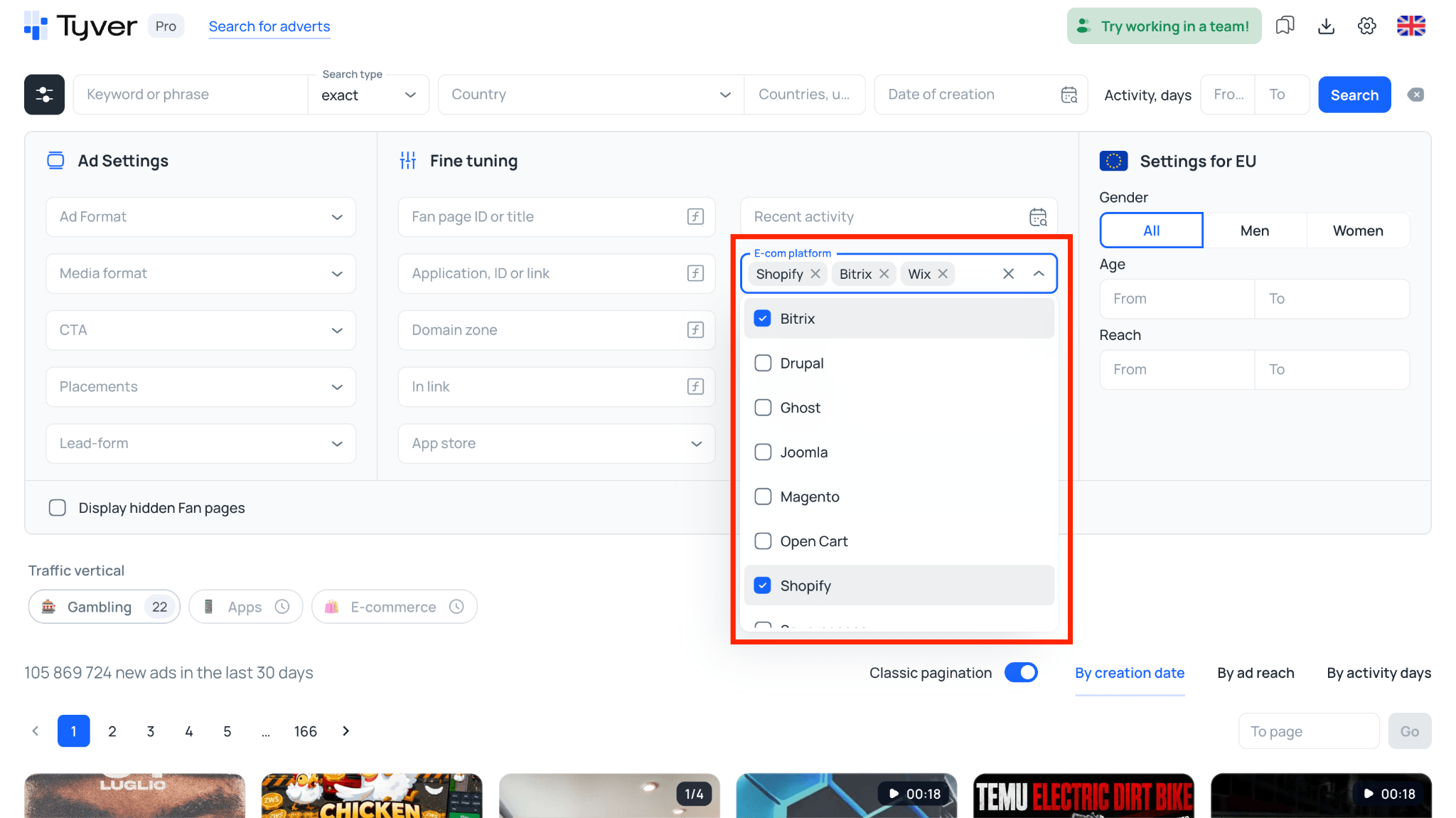
- E-Commerce Platform Filters: Allows you to isolate ads based on specific site backends and CMS engines like Shopify, Wix, WooCommerce, Joomla, and many others. This setting completely strips out gambling, nutra, or crypto offers from your feed, leaving you with pure e-commerce store placements. Pairing this with a Call-to-Action (CTA) filter for «Shop Now» or «Buy Now» narrows your results down exclusively to high-intent physical products that your competitors are aggressively scaling right now.
- Real-Time Feed Freshness: The database updates every few hours, ensuring fresh creative concepts appear almost immediately after launching. Crucially, the scraper successfully indexes aggressive grey-hat ads before Facebook moderation flags and tears them down. This gives you a direct look at live, high-converting angles that are actively bypassing compliance checks right now.
- Dedicated iGaming & Gambling Hub 🎰: A dedicated control panel toggle that instantly purges irrelevant mainstream ads from your results. This eliminates the need to manually build keyword sheets and compile slot names across multiple languages for different GEOs. Tyver automatically aggregates ad variations for trending crash games and slots (such as Aviator, Plinko, Sweet Bonanza, and Gates of Olympus), separating them from white-hat retail products in a single click.
- Unmasked EU Impression Metrics: While the official Meta Ad Library hides detailed delivery metrics and demographic data for European countries, Tyver bypasses these privacy locks. It displays exact view counts and impression statistics directly on the ad card, allowing you to instantly identify high-budget campaigns that your competitors are pumping serious spend into.
- Funnel Reverse-Engineering via Domain and Fan Page: The «Similar Ads» tool allows you to pull every single active campaign tied to a specific Fan Page or driving traffic to a particular domain in one click. This makes it incredibly easy to completely unpack a competitor’s setup, unearthing their hidden pre-landers, landers, and backend tracker links.
- On-the-Fly Creative Uniqueizer: Bypassing Facebook’s Computer Vision algorithms no longer requires exporting assets to third-party software or Telegram bots. Directly within the ad card, you can tilt video frames, crop borders, and generate up to 10 technically distinct metadata and visual variations, making them ready for immediate upload. 💡
- Team-Centric Workflow Systems 👥: Under the «Team» plan, you can set up standalone sub-profiles for up to 3 buyers. Team leads can configure unique view quotas for each member across three modes: Strict (a hard cap that blocks further views once the limit is hit), Soft (a warning is sent when the limit is reached but viewing continues), and No Limit (the full team pool is shared across all members). Furthermore, winning creatives can be organized into shareable swipe-file folders and distributed via direct links that open seamlessly — even for recipients who do not have a Tyver account.
- Public API with Documentation: Tyver provides a public API that allows you to integrate the platform into your own programs, scripts, and CRM systems — ideal for teams looking to automate data collection and analysis without manual interface work.
What is Minea? The Complete Dropshipping Ecosystem
Minea was built specifically around the demands of e-commerce and product dropshipping. The software aggregates ads across major networks, primarily Facebook and TikTok, with its database refreshing eight times a day. The platform is entirely geared toward uncovering trending winners and reverse-engineering competing storefronts.
To do this, the service relies on several core modules:
- AI Magic Search: Functions as a reverse-image and title search engine. By uploading a product photo, the software tracks down all exact matches within its database, revealing who else is running the item and on which ad networks. This lets you thoroughly assess market saturation before investing any ad spend.
- Sales Tracker: Built for comprehensive competitor storefront monitoring, specifically targeting Shopify sites. The «Premium» plan lets you track up to 20 concurrent stores, while the «Business» tier bumps that limit to 100. The tool flags any store updates in real time, including fresh product rollouts, price adjustments, active promos, and landing page design overhauls.
- Success Radar: A curated shortlist of the top 100 trending winning products, updated every 8 hours. Locked behind their highest-tier subscription, this feature highlights exactly which items are generating positive ROI across different global markets right now.
- Influencer Spy: An influencer marketing tracking module that covers a database of over 20,000 creators across Instagram, TikTok, and YouTube. This allows you to uncover hidden product opportunities that competitors are scaling directly through creator integrations and sponsored stories.
- Native Shopify Integration: Import any discovered product directly into your own storefront with a single click. The built-in AI assistant automatically generates optimized product descriptions, SEO meta tags, and high-converting marketing hooks for your landing page.
The biggest bottleneck in Minea is its restrictive credit system. Your usage limits are burned by practically every action: running basic search queries, expanding a specific ad card, or pulling deep store analytics. If you are running an active operation, it is incredibly easy to exhaust your entire monthly credit allocation on the entry-level plans within just a few days. 😬
Search Filters and Usability
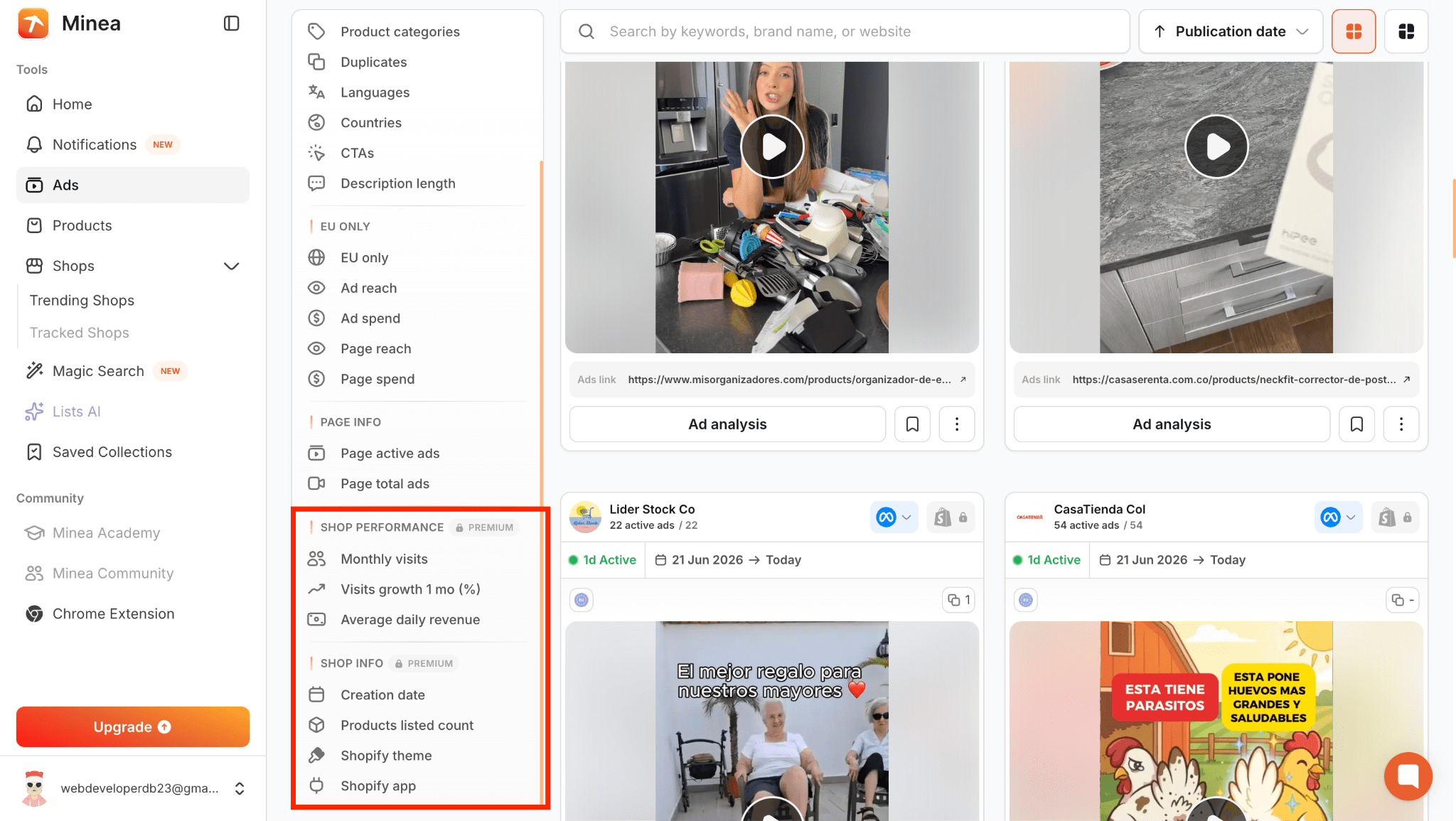
Minea’s control panel is built entirely around product sourcing. The left sidebar contains dedicated tabs for Ads, Products, Shops, Magic Search, and AI curated lists.
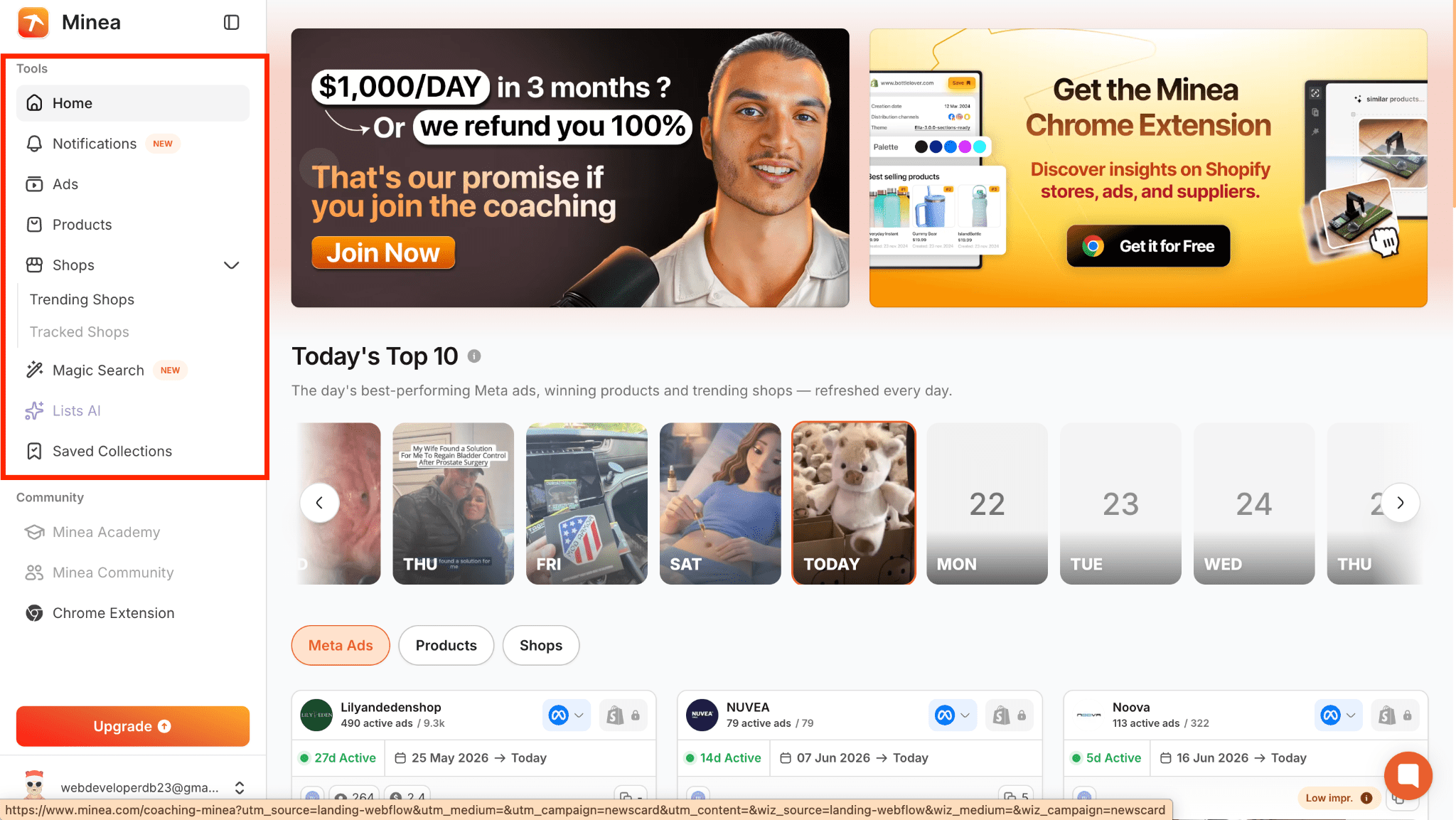
Opening the ad search tab brings up a single column of settings. Along with standard options like publication date or media type, it features highly specific filters including description length, ad duplication counts, and the option to hide low impression placements.
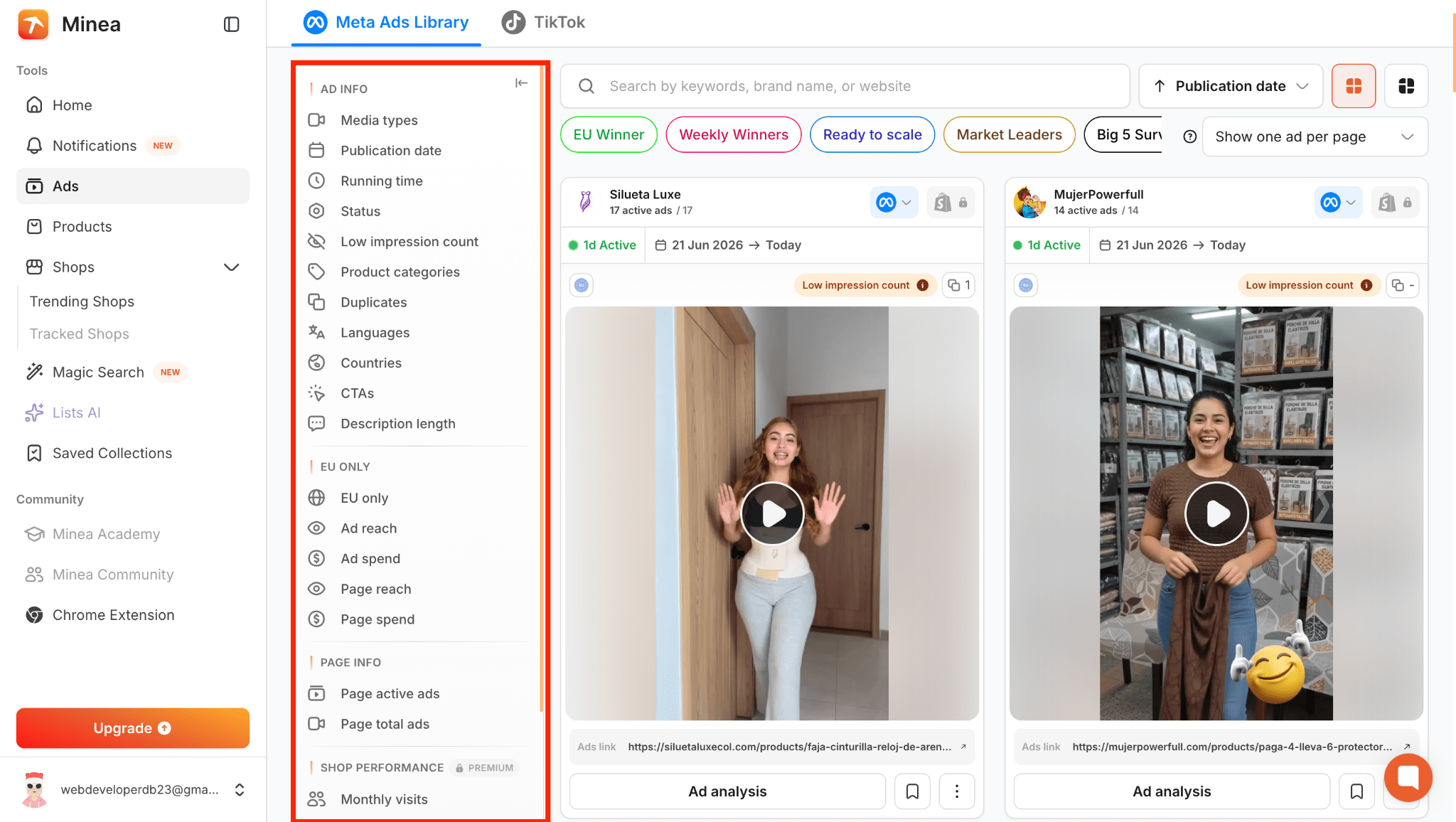
Further down, you will find targeted regional blocks. The «EU Only» subsection lets you analyze ads based on total ad spend, overall reach, and page impressions.
To break down competitor storefronts, the platform provides Shop Performance and Shop Info modules. These allow you to sort results by monthly traffic, store creation date, active Shopify themes, and installed plugins.
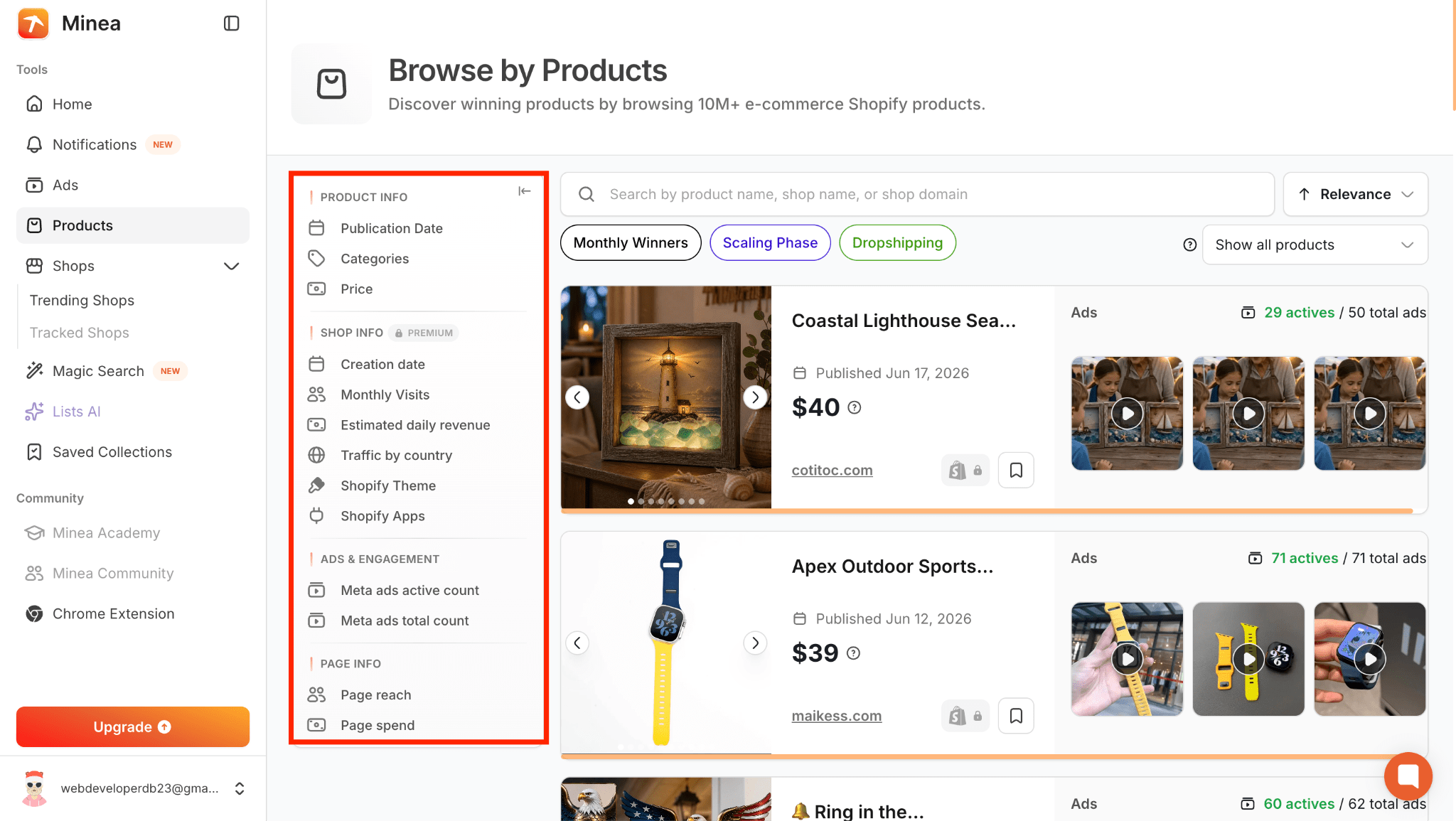
Switching over to the Products section unlocks a separate database of 10 million individual items.
In this tab, you can filter product listings by retail price, specific niches like electronics or beauty, and the total number of duplicate ad sets running across Facebook and Instagram.
This instantly reveals how hard an item is being pushed in the auction. For quick sourcing, Minea includes pre-configured collections like «Monthly Winners», products in the «Scaling Phase», and classic dropshipping winners.
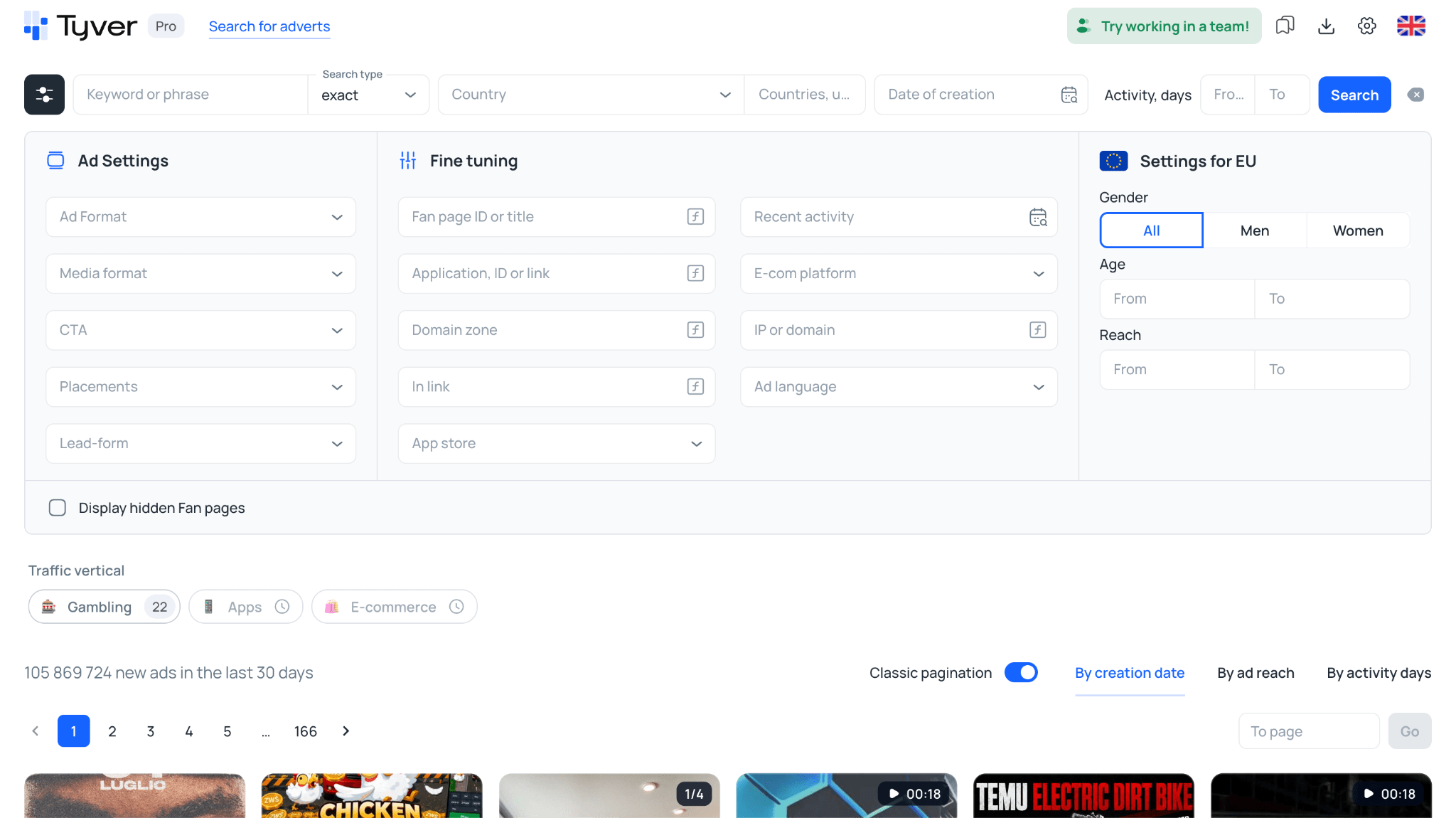
Tyver structures its control panel into three distinct sections: core parameters, advanced settings, and the EU analytics block. All primary configurations like GEOs, keywords, and active ad lifespans sit right at the top of the page.
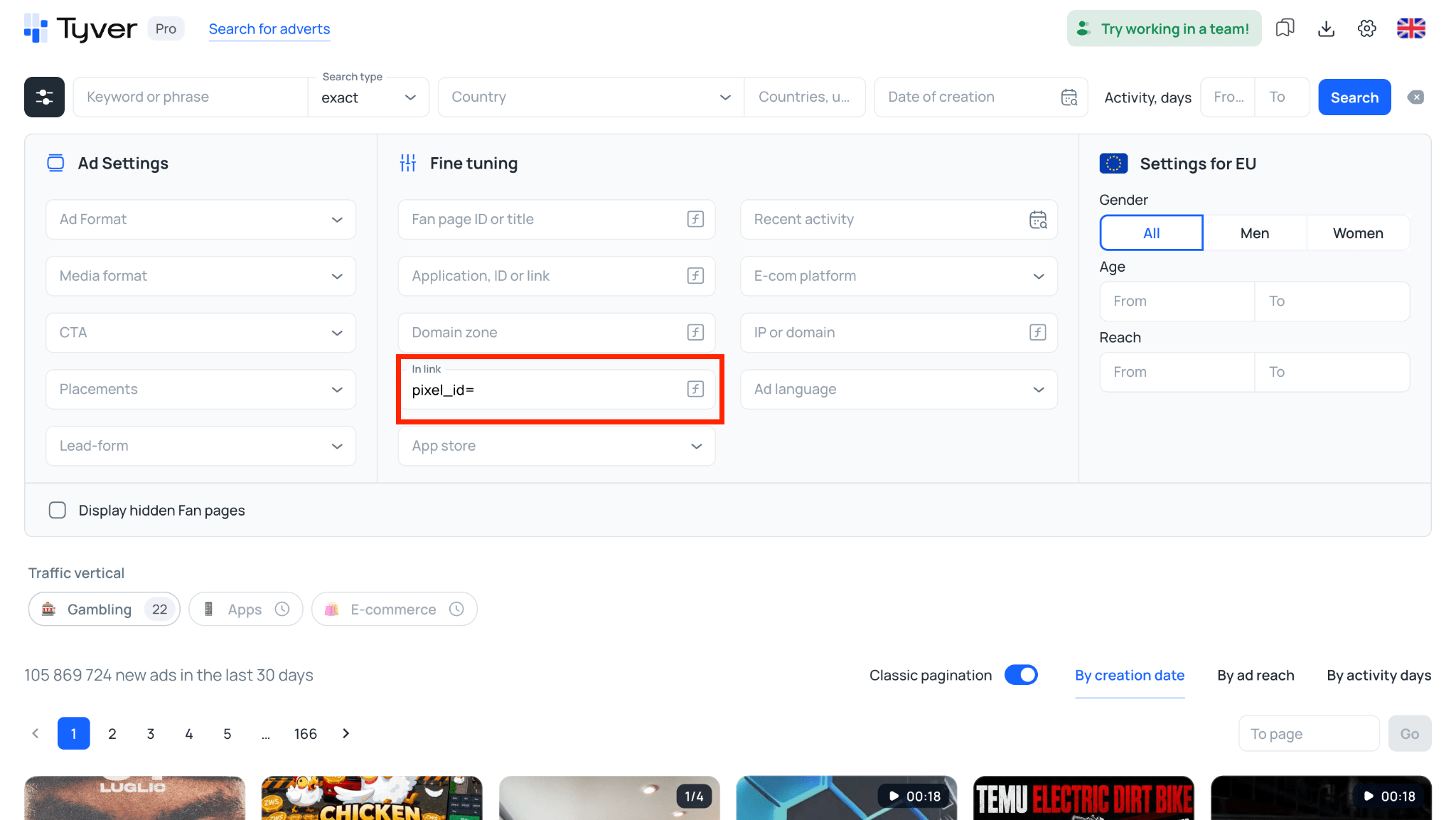
A standout feature of this spy tool is the ability to isolate ads using technical campaign parameters. The advanced configurations block features an «In URL» field where you can enter standard tracker identifiers and macros like pixel_id=, sub1=, utm_source=, or fb=. This query instantly filters out corporate brand noise, leaving only pure affiliate setups in the feed.
For mobile app offers, the platform includes a native marketplace search covering Google Play and the App Store, alongside an app ID input field. You can paste the exact app store identifier here to instantly pull every creative currently live for that specific offer. 📱
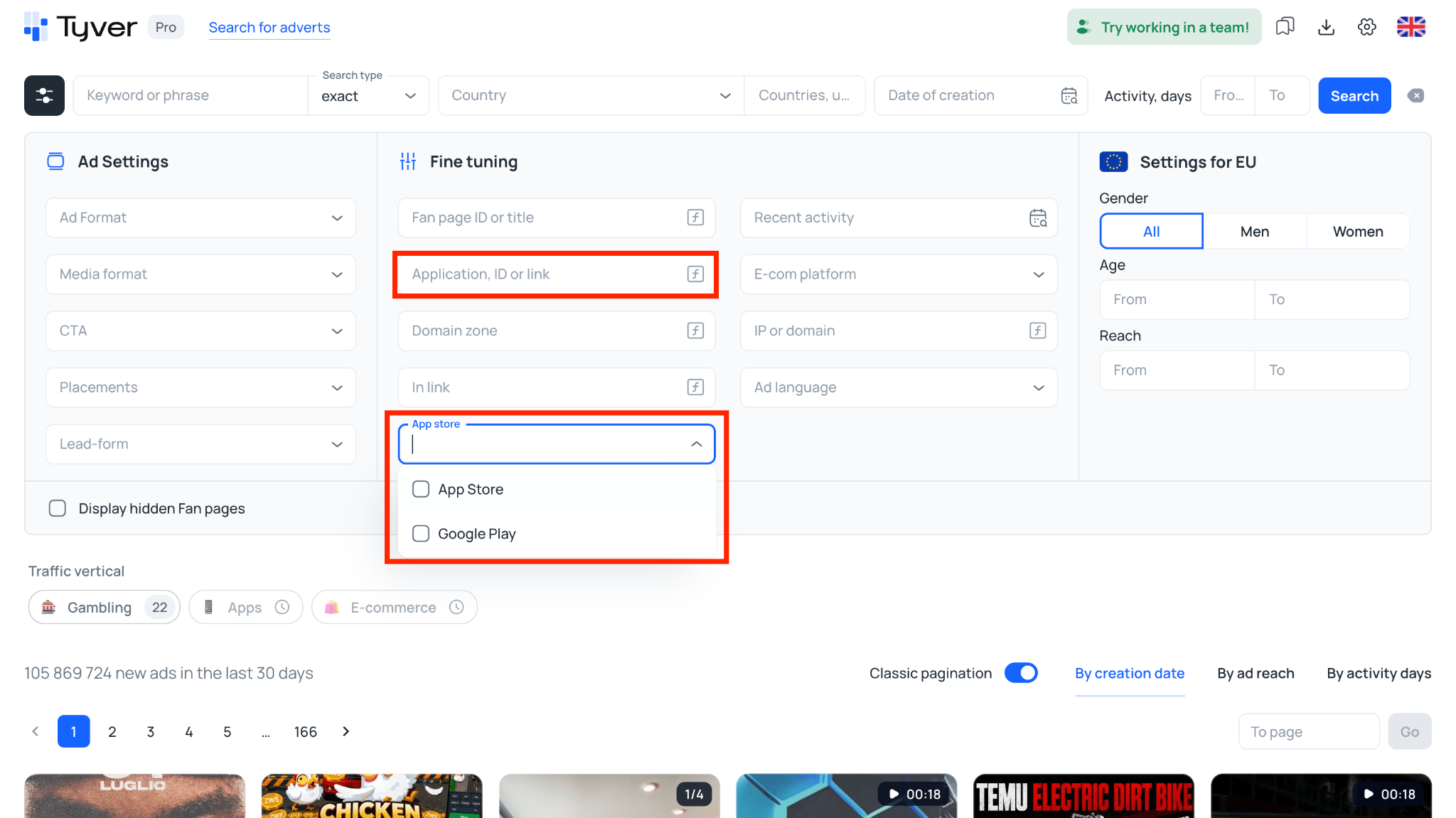
If you run PWA funnels, you can easily combine link filters with call-to-action buttons by inputting tracker macros in the URL field while selecting CTAs like «Download», «Play Game», or «Install Now».
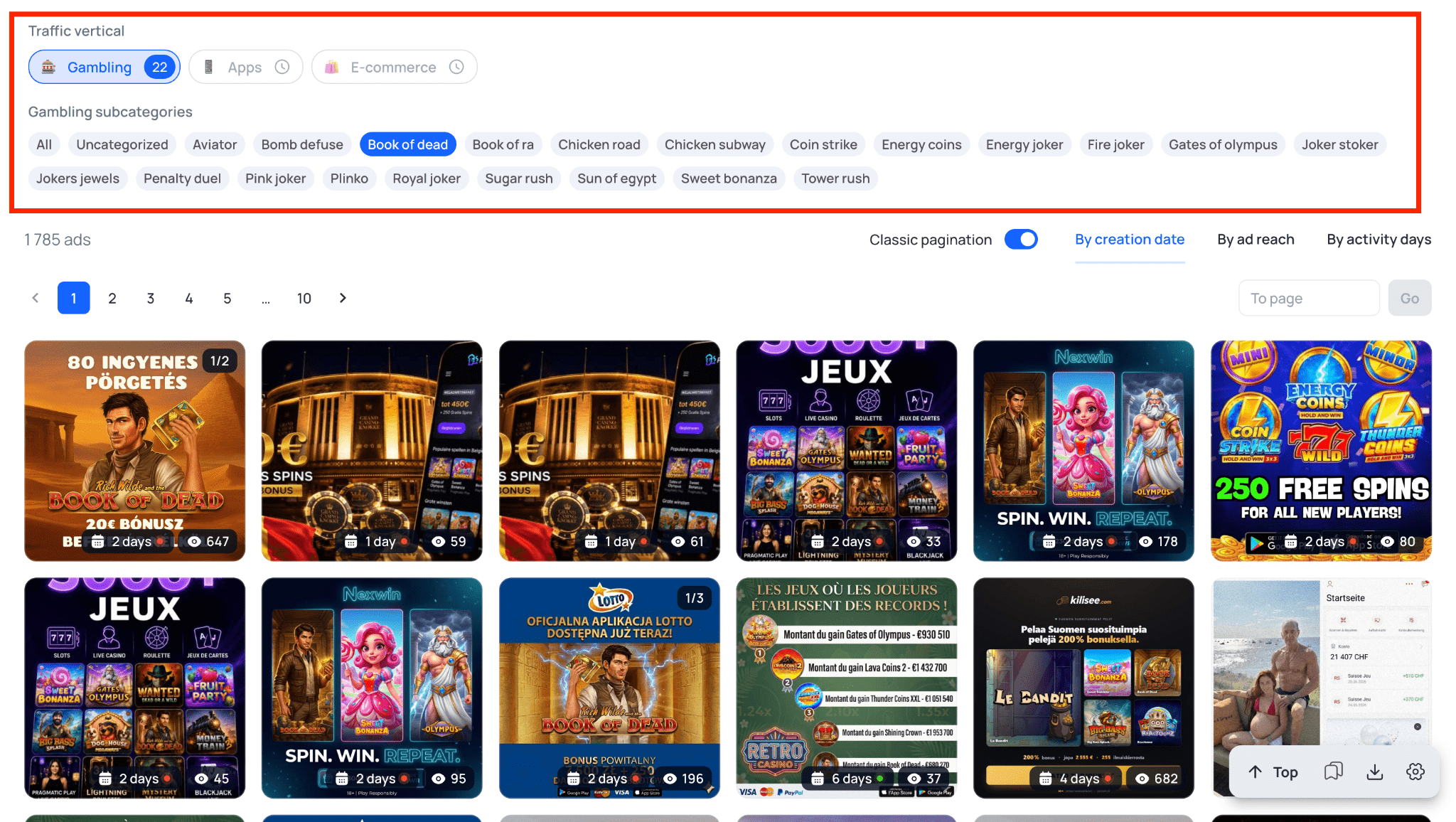
The «Gambling» category clears out all the noise in a single click. 🎰 The system automatically aggregates creatives tailored to specific slots and crash games like Aviator, Plinko, Sweet Bonanza, and Gates of Olympus, eliminating the need to manually compile keywords across different languages and GEOs.
At the same time, the spy tool works perfectly for white-hat niches. Dropshippers and e-commerce media buyers can use it to source trending products for their stores. Tyver provides filters for «Shop Now» or «Buy Now» CTAs alongside e-commerce platform filters like Shopify, Wix, or Joomla, letting you unearth competitor landing pages instantly. 🛍️
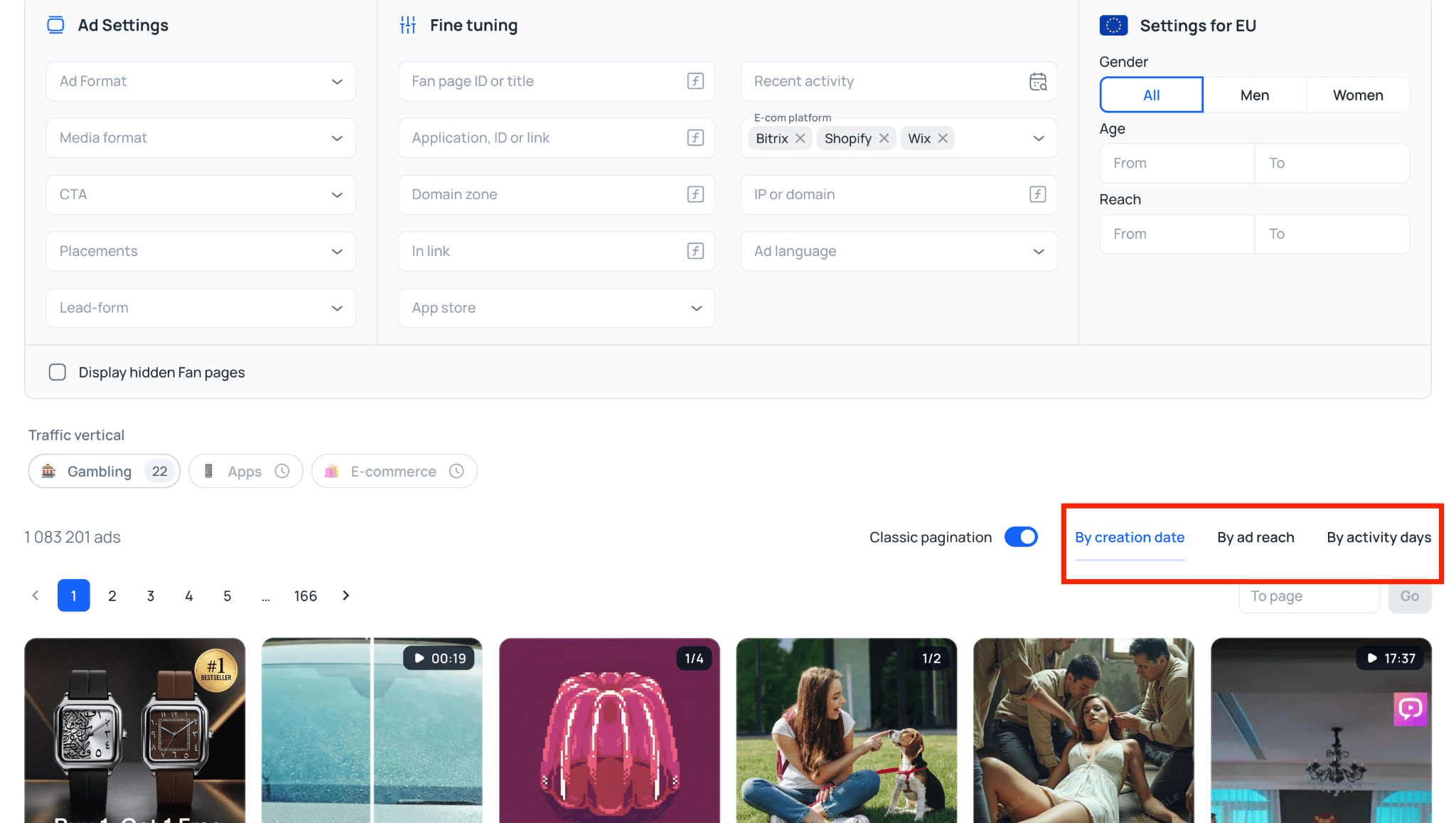
Active lifespan is the metric you should focus on first. If an ad has been running for 10 to 14 days and is steadily gaining impressions, it means the campaign has successfully found its audience, and you can confidently use this angle as a blueprint for your own creatives. 📊
Analytics and Metrics
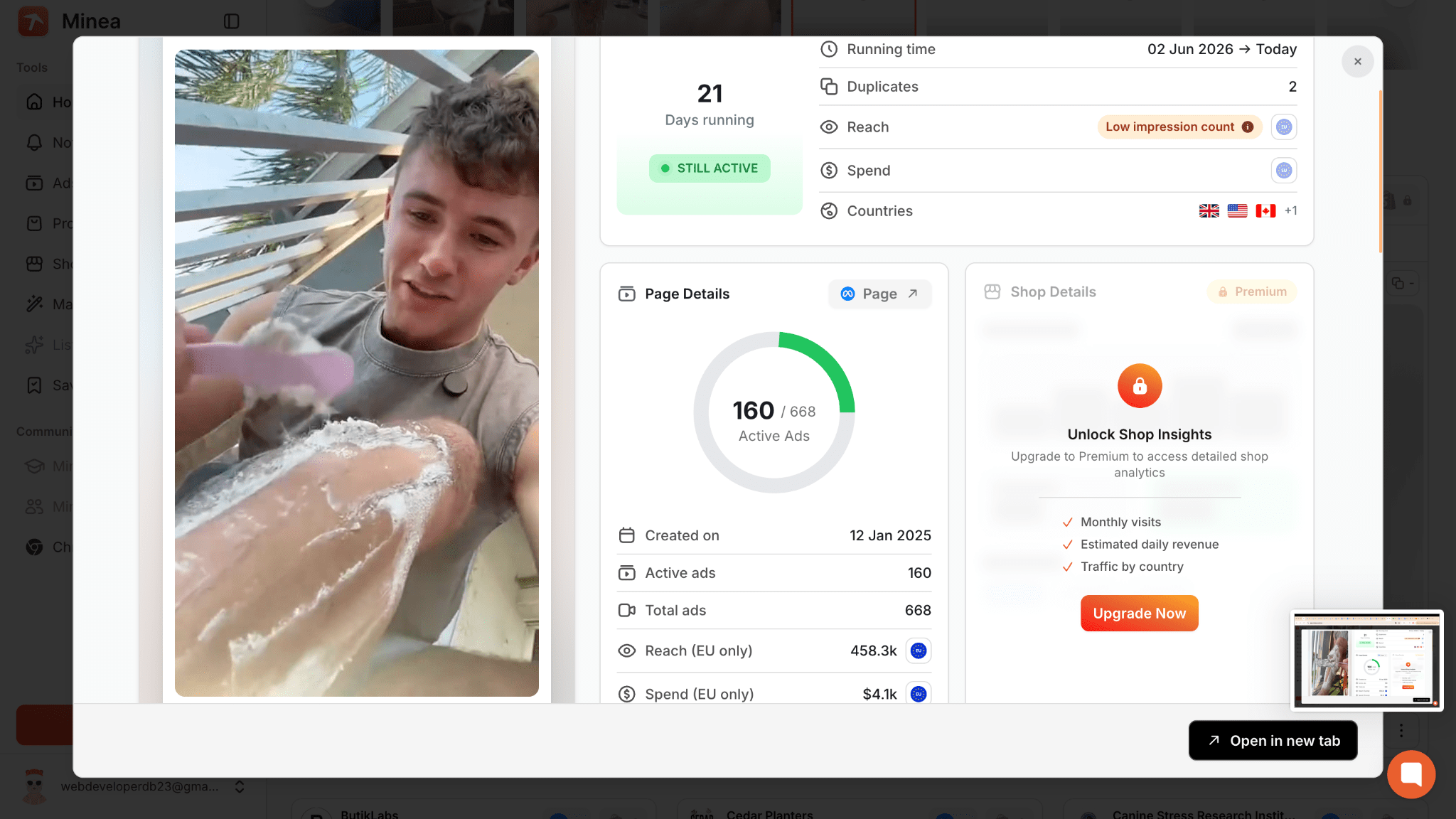
In Minea, the ad card analytics are tailored strictly for dropshipping operations. Inside the card, the spy tool displays the creative’s active lifespan, duplication counts, target GEOs, and current delivery status.
Below that, it pulls data for the Fan Page itself, including its creation date, the number of currently active ads, and its historical launch volume. Advanced storefront analytics, such as monthly traffic, estimated revenue, and geographic traffic breakdown, are locked behind the «Premium» tier, meaning this data remains completely hidden on entry-level plans.
Tyver structures its analytics specifically for rapid targeting optimization and fast tracking winning angles. The ad card displays precise reach metrics along with the gender and age breakdown of the audience. However, it is important to note that these demographics are exclusively available for EU countries, as Facebook does not provide this data for other regions.
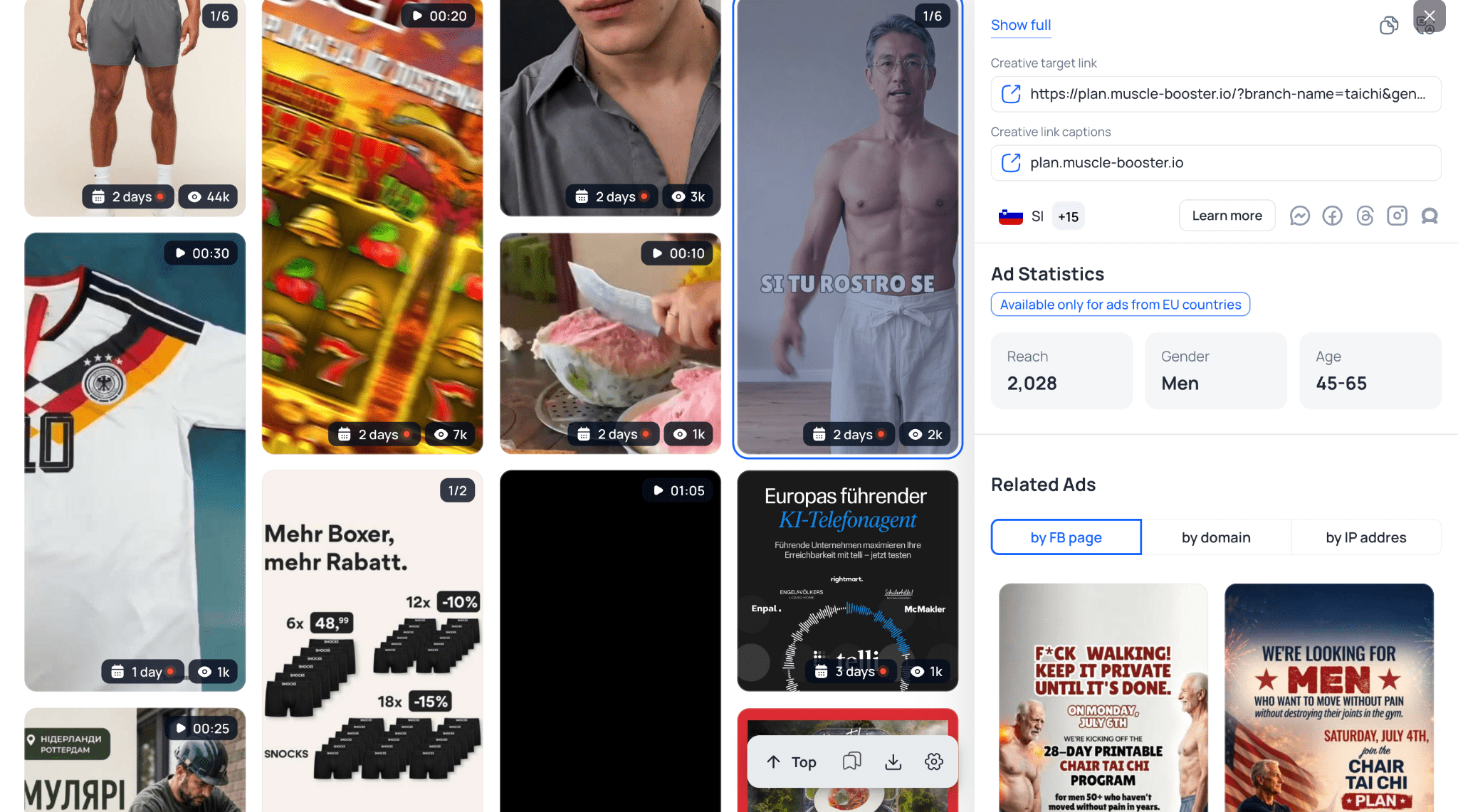
Further down the card, you will find the «Similar Ads» module. With a single click, you can pull every single creative a competitor has launched from that specific Fan Page or directed at the same domain. This allows you to immediately review alternative ad copy or different visual variations within a single campaign infrastructure.
The tool also features an IP address lookup that detects ads linking to landing pages hosted on the exact same server. This makes it incredibly easy to unmask other domains owned by the same team, even if they are scaling traffic from completely different accounts and using entirely separate site names.
Pros and Cons of Tyver vs Minea
✅ Tyver Pros:
- Deep Meta Scraping Capabilities: The spy tool extracts the maximum possible volume of ads across Facebook, Instagram, Messenger, and Threads, significantly outperforming competitors in terms of total database scale.
- Technical Filters for Affiliate Marketing: Sourcing by specific URL strings and tracking tokens like pixel_id= or sub1= allows you to quickly filter out mainstream white-hat ads and isolate WebView or PWA funnels.
- Dedicated Gambling Hub: A single-click feature aggregates targeted creatives for online casinos and trending crash games, saving you the hassle of manually collecting keywords for different target regions.
- E-Commerce Platform Mapping: Filtering by specific site engines like Shopify, Wix, or WooCommerce completely purges affiliate ads for verticals like gambling or nutra from your feed, leaving you with pure online retail placements.
- Granular EU Demographics: The ad card reveals accurate reach metrics alongside the exact age and gender breakdown of the target audience inside the European Union.
- Fan Page and Domain Reverse-Engineering: The similar ads tab lets you instantly view every creative launched from a specific Fan Page or track down websites hosted on the exact same IP address.
- Team Collaboration: The Team plan supports up to 3 members with flexible limit controls across three modes (Strict, Soft, No Limit) and sharable creative folders via direct link.
- Public API with Documentation: Tyver provides a public API that allows you to integrate the platform into your own programs, scripts, and CRM systems — perfect for teams looking to automate data collection and analysis.
❌ Tyver Cons:
- Platform Limitations: The spy tool exclusively scrapes ads within the Meta ecosystem, meaning there is no coverage for TikTok traffic.
- Verticals Still in Development: One-click rapid filtering is currently only available for gambling, forcing you to manually configure settings and search queries for all other niches.
✅ Minea Pros:
- Multi-Channel Coverage: The platform aggregates ad creatives across Facebook, Instagram, and TikTok concurrently.
- Storefront Reverse-Engineering: The «Premium» tier unlocks monthly traffic metrics for Shopify sites, along with their estimated revenue and active plugins.
- Pre-Built Product Database: The «Products» section features granular category filters and pre-configured tags, significantly streamlining the process of sourcing trending items for dropshipping.
❌ Minea Cons:
- Shallow GEO Scraping Depth: Because the platform splits its resources across multiple networks at once, its database depth for specific countries suffers, causing many localized ads and trending items to slip through the cracks.
- Expensive Pricing Tiers: Entry-level plans are heavily restricted, while critical features like store revenue tracking and deep analytics are locked behind top-tier plans that require serious financial overhead.
- Lack of Affiliate-Centric Filters: The platform does not allow you to filter ads by tracker macros, server IP addresses, or specific mobile app identifiers.
Pricing Plan Analysis: Which Offers Better Value?
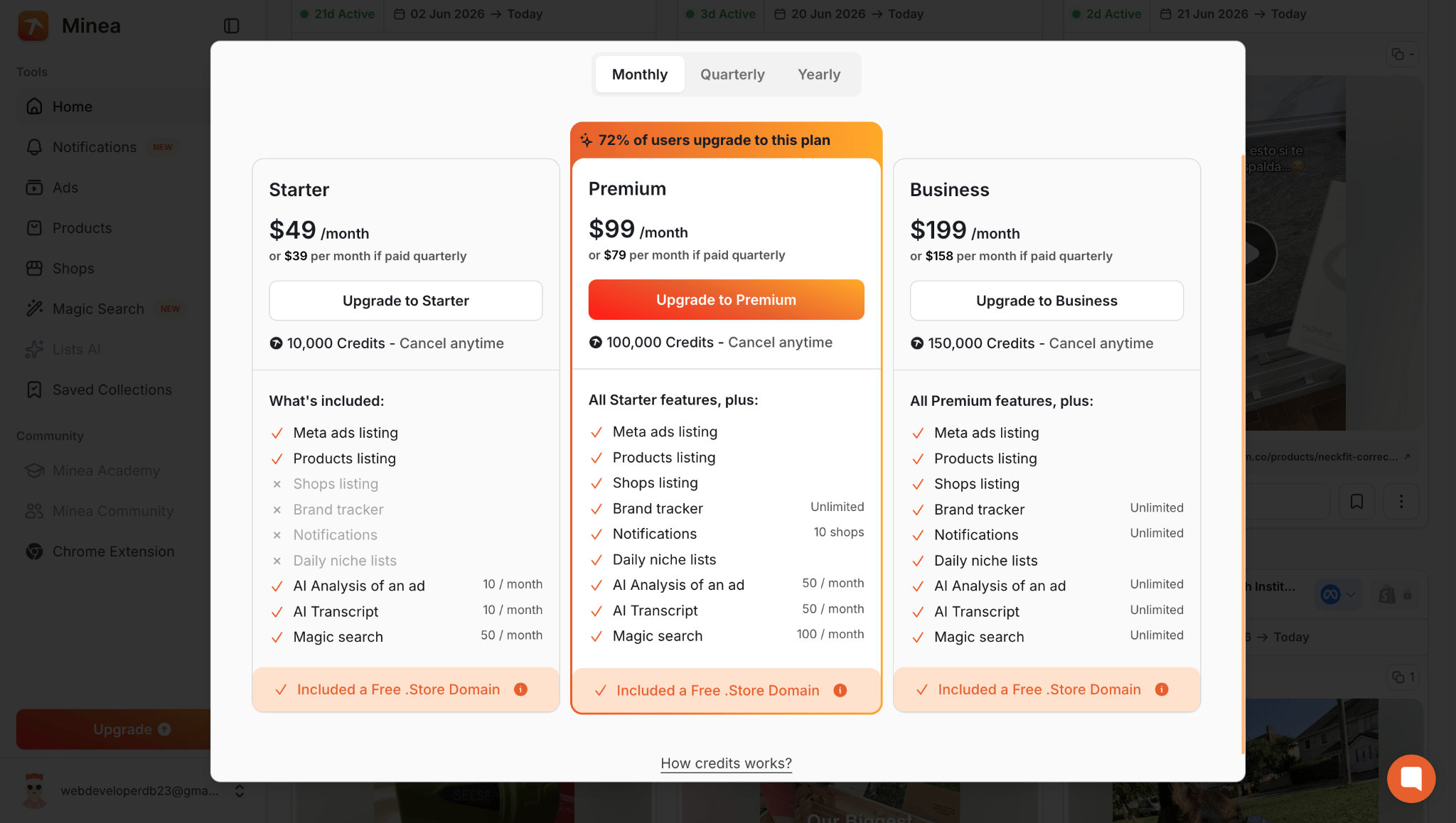
Minea’s pricing structure is tied directly to a credit system, where credits are consumed for every search query and ad view. New users get 200 free credits to test the platform. The entry-tier paid plan, «Starter», is priced at $49 per month (or $34/month on annual billing). For this price, you receive 10,000 credits and access strictly to Facebook and Instagram ads. If you require TikTok search functionality or Shopify storefront analytics, you will have to step up to the «Premium» tier at $99 per month, which bumps your limit to 100,000 credits.
For media buying teams, they offer the «Business» plan at $199 per month, providing 150,000 credits and trending product shortlists refreshed three times a day. If you are running an active sourcing operation, these limits can easily be burned right in the middle of your competitor research, forcing you to pay extra to run additional searches. 😬
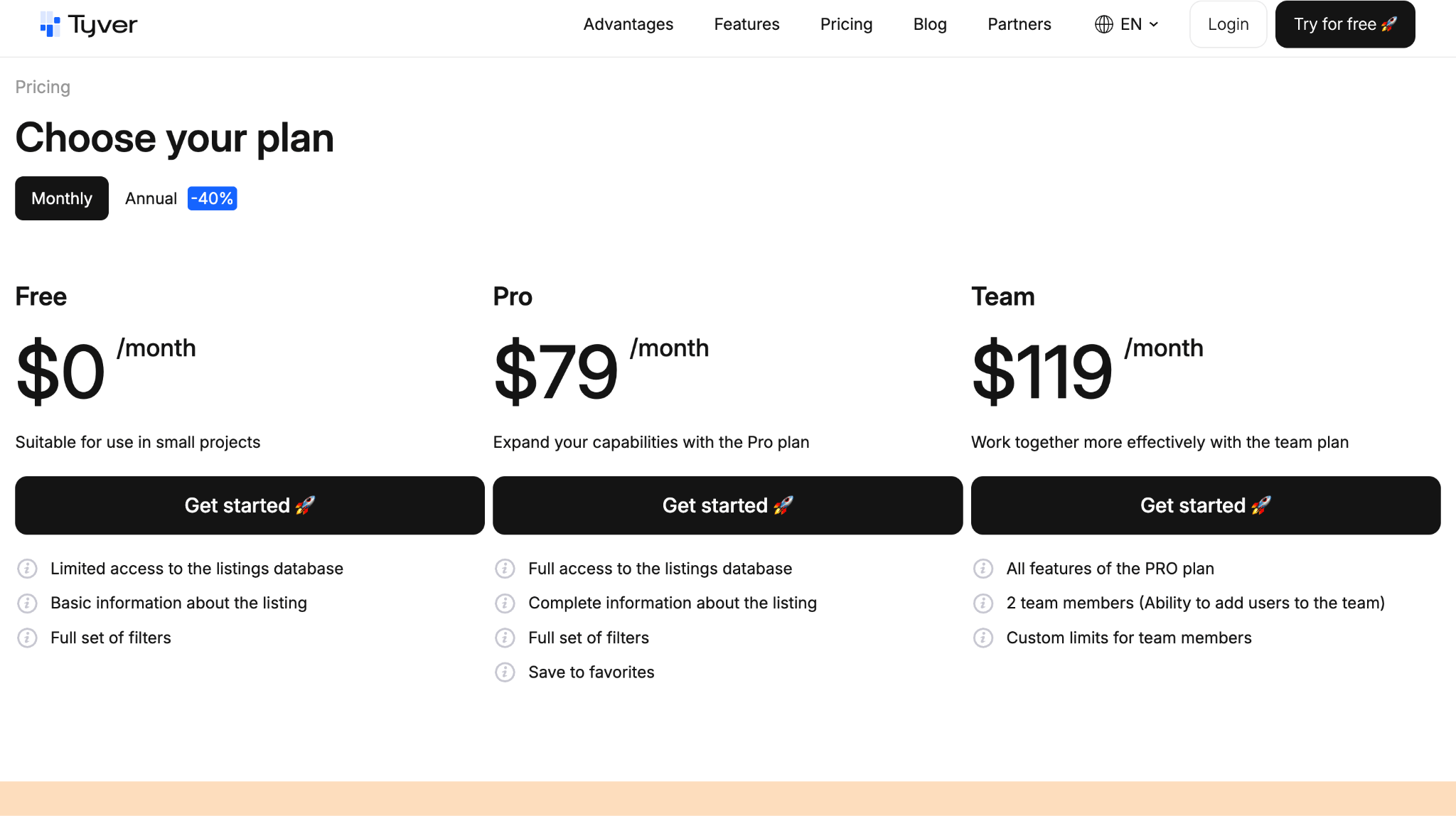
Tyver structures its pricing much more simply, with tiers differing only by team functionality and overall view limits. You can get started with their free option, which unlocks all basic filters but heavily restricts feed results.
The fully featured «Pro» tier is priced at $79 per month and includes up to 30,000 ad views. It unlocks text and tracking link fragment search queries, precise sorting by actual EU reach, the dedicated «Gambling» category, and the ability to save your findings into standalone folders.
For collaborative operations, the «Team» tier costs $119 per month. 👥 It includes up to 60,000 ad views per month, supports up to 3 team members, and lets team leads distribute view limits in three modes: Strict, Soft, and No Limit. The plan also includes sharable creative collections via direct link. Opting for an annual billing cycle grants a 40% discount, dropping the effective price of the Pro plan to roughly $47 per month.
When comparing the two platforms strictly by operational costs, Tyver offers a significantly better ROI for affiliate marketing. In Minea, spending $49 gets you a heavily restricted toolkit where your limits can easily evaporate over a couple of days of intensive competitor research. With Tyver, a comparable budget grants you complete search access across the entire database with no hidden restrictions on advanced filters or ad exports.
Who is Tyver for and Who is Minea for?
Choosing between these two platforms comes down entirely to your specific operational goals. While both tools were originally engineered for completely different target audiences, their feature sets now overlap in several areas.
Tyver was built from the ground up for affiliate media buying, making it the go-to workspace for solo buyers and media buying teams looking to track down PWA funnels via tracker macros or map out competitor domains using server IP addresses. At the same time, the platform functions exceptionally well for traditional dropshipping. Thanks to its native e-commerce platform mapping and Call-to-Action filters like «Shop Now», you can easily source trending items while stripping out everything except pure online storefront placements.
On the flip side, Minea is tailored strictly for sourcing physical products for Shopify stores across Facebook and TikTok. Attempting to deploy this spy tool for affiliate verticals like iGaming or mobile app offers is a waste of resources. Without technical link-parsing filters, finding targeted campaigns is practically impossible, and your credit limits will evaporate as you burn them on random ad views. However, if your core focus is rapidly validating e-commerce products across alternative ad networks, it remains a highly effective solution.
The Verdict
This breakdown highlights the exact use case for each platform, ensuring you do not overpay for features you will never use. 🙂
Minea is built exclusively for traditional dropshipping and product sourcing across various e-commerce platforms. The steep subscription cost is only justified if you actually need to spy on competing storefronts, monitor their monthly traffic, and analyze estimated sales data.
If you are running traffic to gambling, nutra, or even standard e-commerce offers through the Meta ecosystem, Tyver is the superior choice. The spy tool provides a massive ad database, lets you reverse-engineer setups using tracker macros or server IP addresses, and its flat-rate pricing model allows you to conduct competitor research without worrying about running out of limits mid-workflow.
Create a free account on Tyver to test out all the search configurations for yourself, quickly unpack competitor funnels, and uncover winning angles that you can deploy right now. 🚀