Sweepstakes in 2026: what are they, is the vertical still alive, and how can you find winning combinations with Tyver? 🎁
Sweepstakes barely get any attention in affiliate marketing in 2026. Case studies and in-depth articles on the vertical are extremely hard to find. But take a look at spy tools, and you’ll see a different picture: sweepstakes ads are still running actively, with new creatives appearing on a regular basis. 🤔
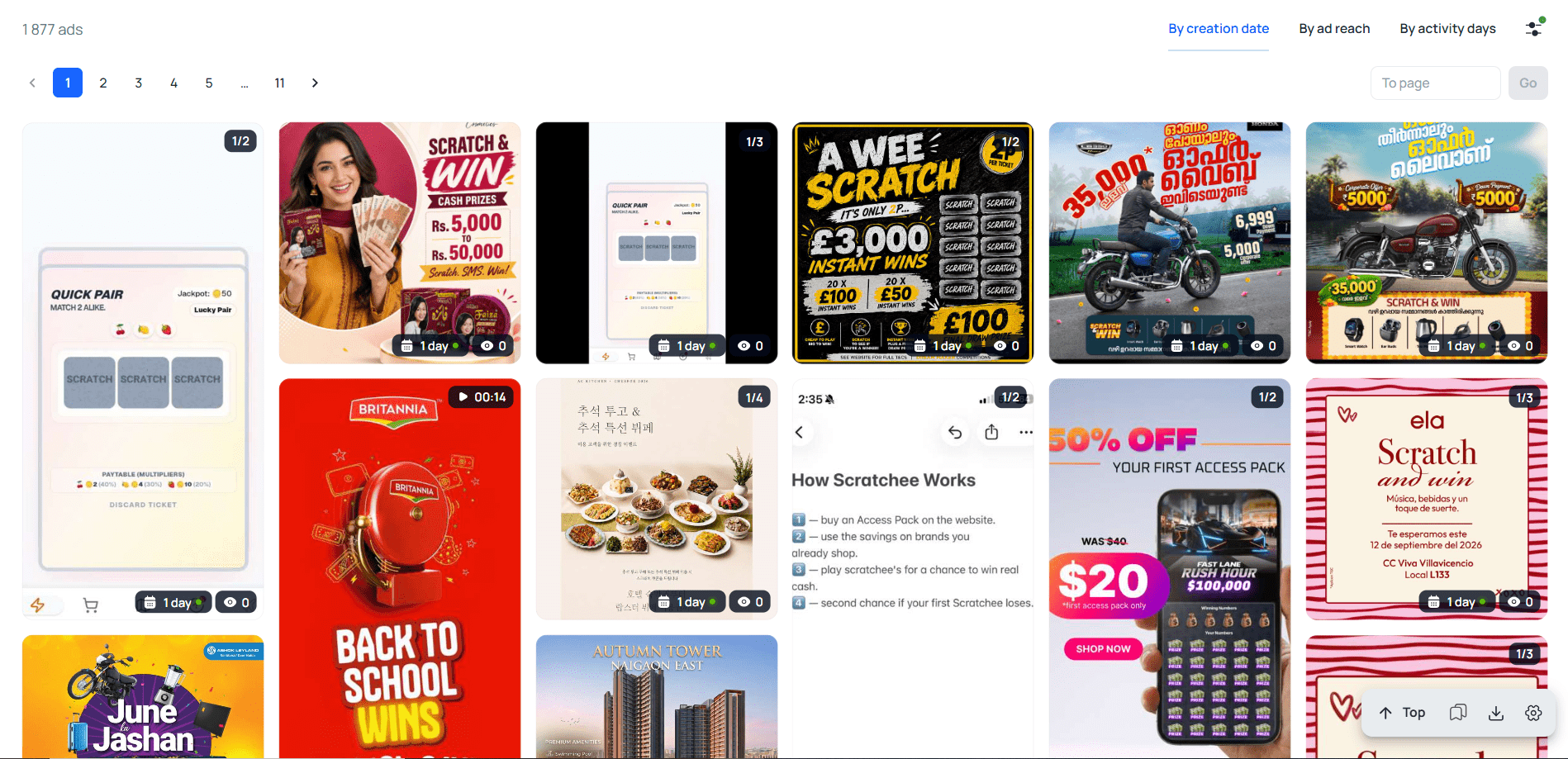
So, the vertical is clearly still alive and worth taking a closer look at. 🔥
What are sweepstakes in affiliate marketing?
Sweepstakes are prize draws. Users provide their contact details or credit card information, or even make a small payment of $1-2, for a chance to win valuable prizes.
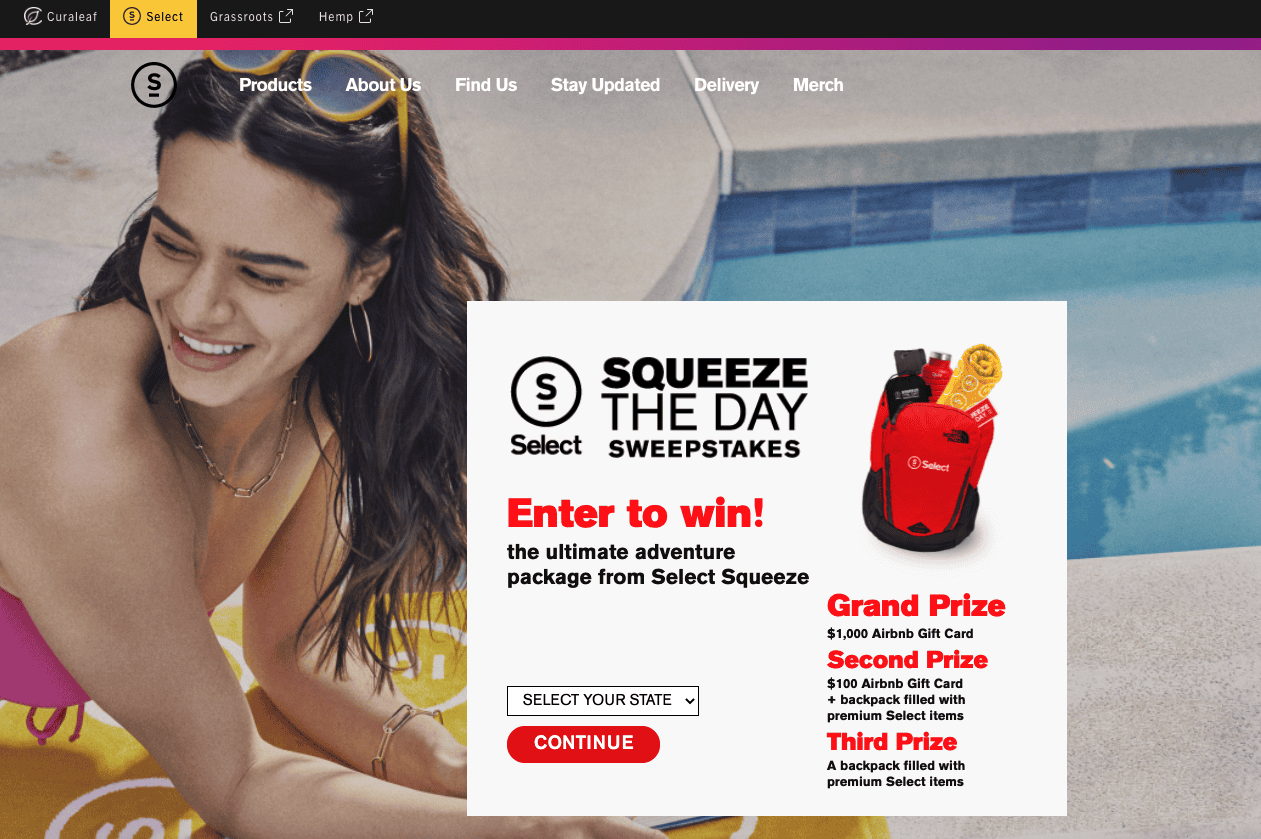
Example of a sweepstakes page where users enter their contact details to participate.
Providing user data is the target action in this affiliate marketing vertical. Sweepstakes offers vary depending on how complex the required action is. Getting a user to submit an email address is the easiest. Getting a phone number is slightly harder, while getting them to confirm a $1 payment by bank card is more difficult still.
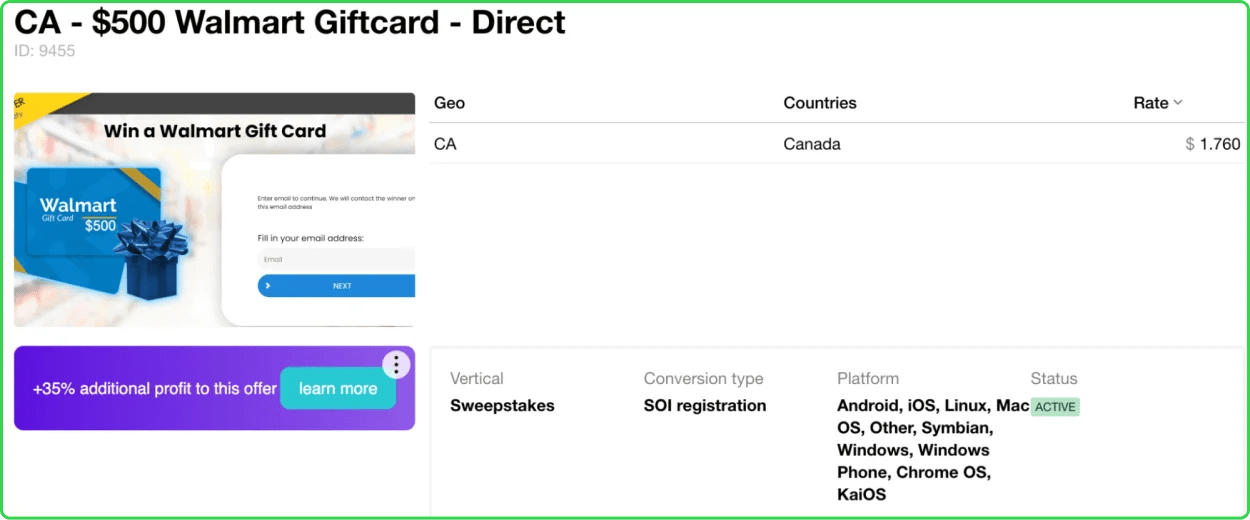
Example of a Canadian offer that pays for users’ contact details.
SOI and DOI offers, as well as PIN and CC Submit
💵 These abbreviations refer to the types of target actions advertisers pay affiliates for:
- SOI (Single Opt-In). Affiliates get paid when users submit their contact details, such as an email address or phone number. Payouts range from a few cents to a couple of dollars;
- DOI (Double Opt-In). Affiliates get paid when users submit and verify their contact details. To trigger a payout under the DOI model, a user must not only enter their email address or phone number but also verify it by clicking a link in an email or entering a code received via SMS. This conversion is harder to get, so payouts start at around $0.10 and can reach $5-6;
- PIN and CC Submit payout models are much less common among sweepstakes affiliate programs. These require users to enter a code received via SMS or provide their bank card details. The user has to complete more steps and also make a small payment, even if it is only a token amount. Payouts range from a couple of dollars in Tier 3 GEOs to a few dozen dollars in Tier 1.
How and where to get traffic for sweepstakes
You can drive traffic to sweepstakes offers from Facebook, TikTok and Google Ads, as well as push notifications, teaser ads and pop-ups.
The general rule is simple: the higher the payout for the target action, the more expensive the traffic sources you can afford to use for sweepstakes. 📈
Push notifications and teaser ad networks for sweepstakes
💸 These are among the cheapest traffic sources, not only because of their low CPCs, but also because they don’t require an antidetect browser, proxies or cloaking. Getting started is straightforward:
- Choose an offer;
- Get your affiliate link and set up tracking;
- Test the offer and, if the initial results look good, optimise the campaign by creating blacklists for sites that send unprofitable traffic.
☝️ If the campaign remains consistently profitable after optimisation and blacklisting poor-performing sources, you can keep it running. If optimisation doesn’t improve the results and the campaign only breaks even or remains unprofitable, it’s better to stop it. A genuinely profitable combination usually shows potential almost from the start.
Because traffic is cheap and campaigns require source blacklisting, push traffic and teaser networks are best suited to offers with simple, low-cost flows, namely SOI and DOI. For push traffic, we recommend choosing offers with payouts between $0.60 and $3.
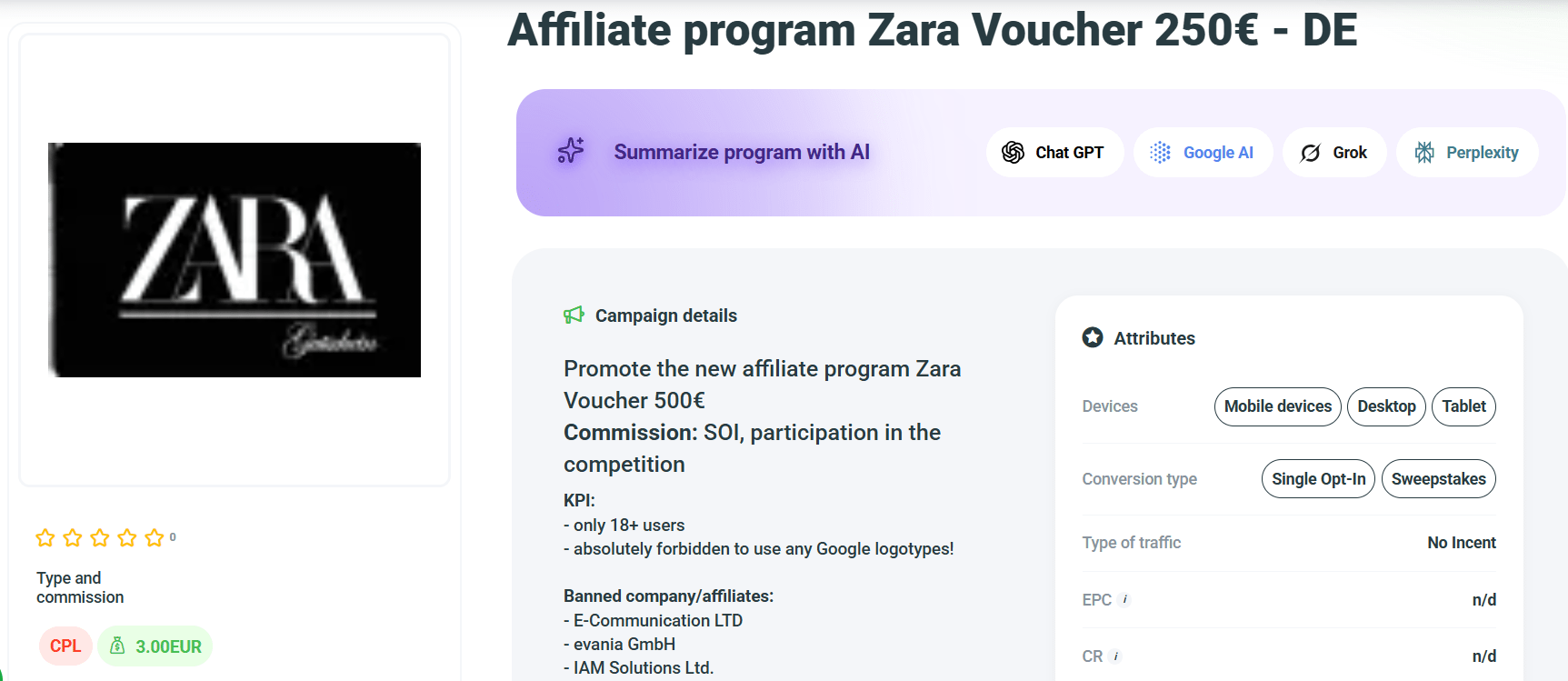
Offers with lower payouts are unlikely to cover the cost of even very cheap traffic. Offers with more complex, higher-paying flows, on the other hand, require a much larger testing budget.
Facebook Ads for sweepstakes
Facebook is a more challenging traffic source due to higher traffic costs and the need for antidetect browsers, proxies, cloaking and payment methods. You also need a domain and hosting to create your own links to the offer landing pages, as Facebook won’t approve direct affiliate links.
That’s why Facebook generally makes sense for offers paying $3 or more per lead. However, these offers usually involve more complex conversion flows, such as PIN Submit and CC Submit. Even in Tier 1, very few advertisers will pay $4-5 for a simple registration. Facebook’s main advantage is its ability to find the right audience and optimize campaigns for more complex flows, such as entering an SMS code or submitting bank card details.
👀 In 2026, sweepstakes are still being actively promoted on Facebook, which is easy to see in the Tyver ad spy tool.
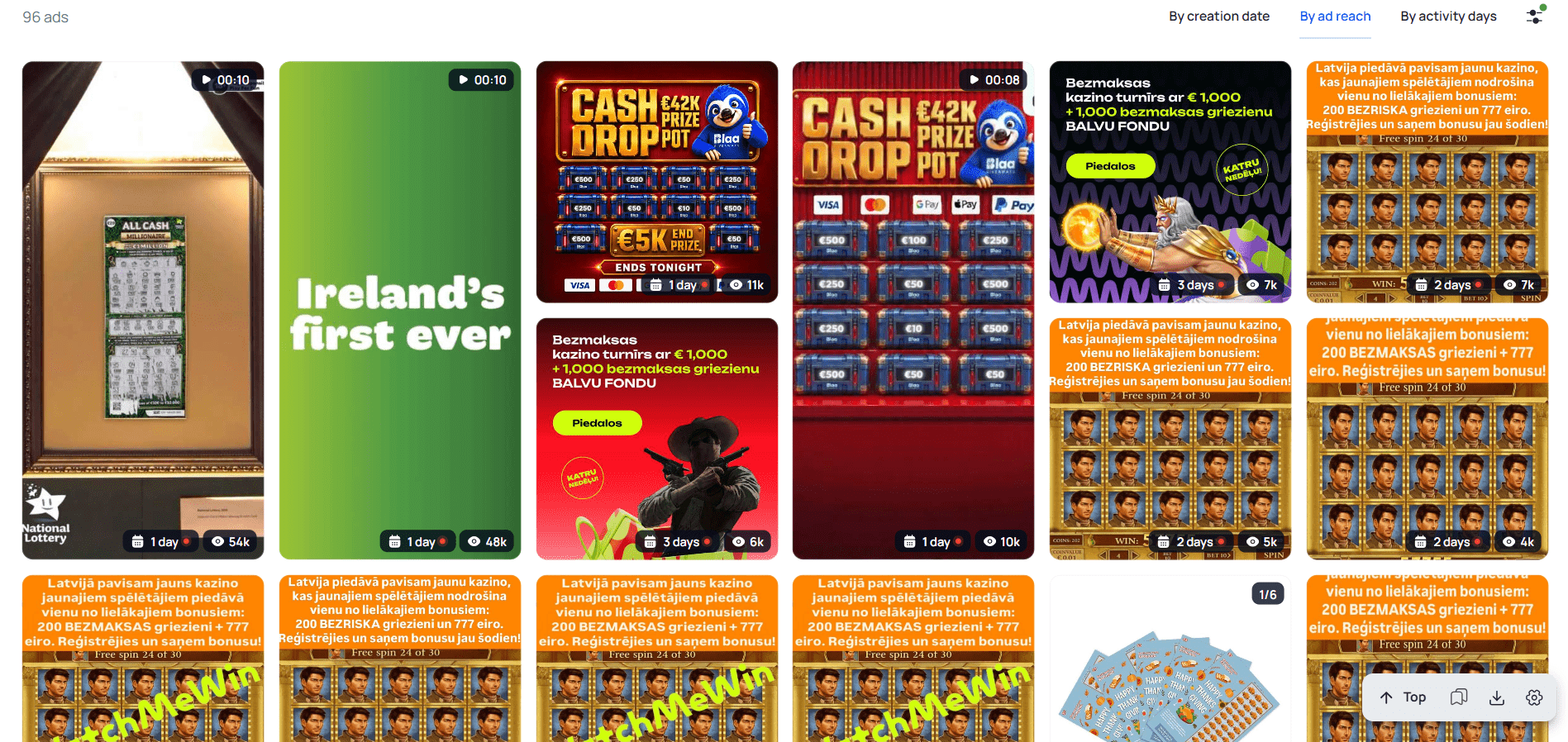
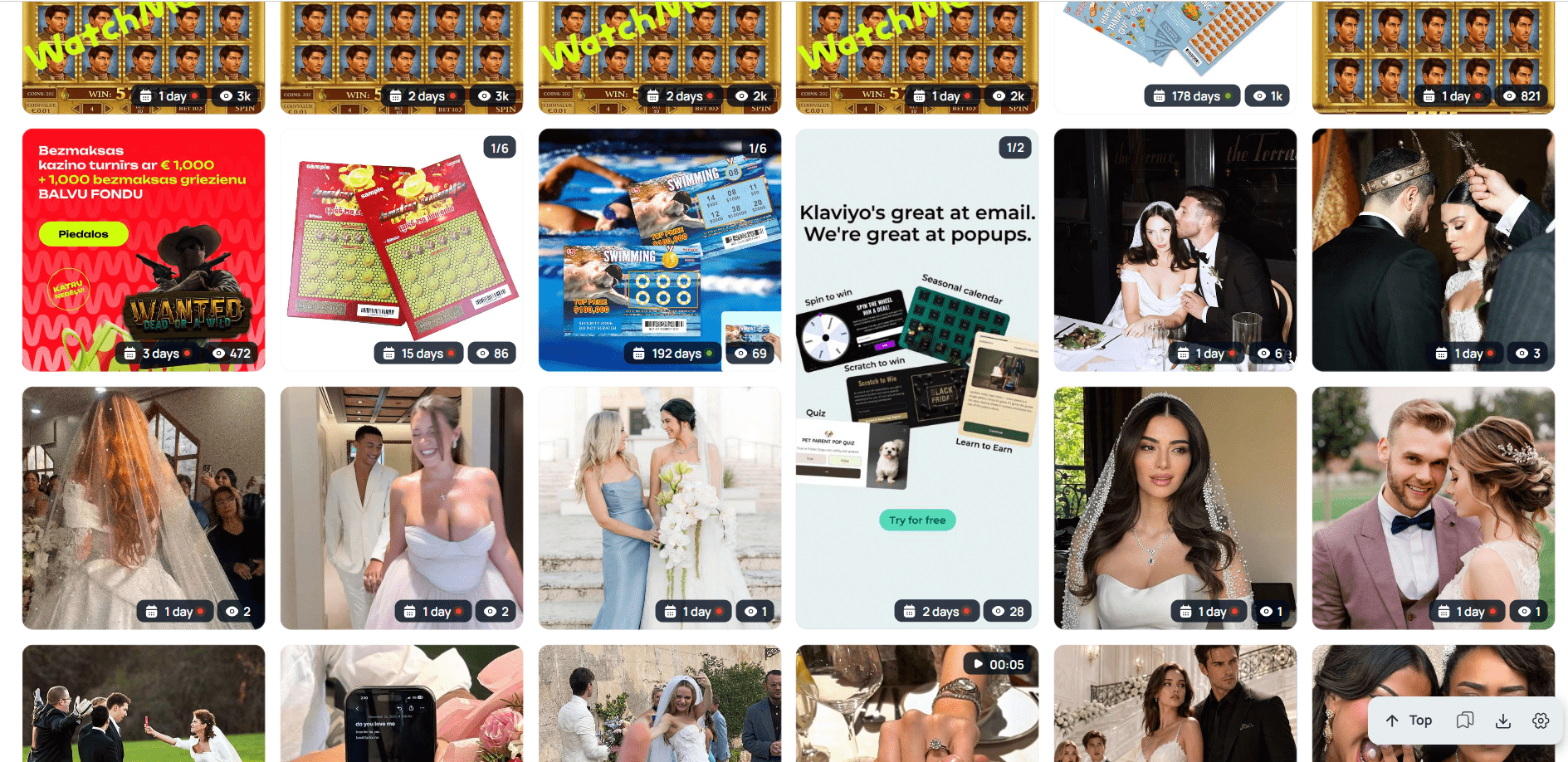
The Facebook launch process looks like this:
- Create a prelander (quiz, spin-the-wheel, mystery boxes) along with a white page to get through moderation;
- Set up cloaking;
- Add proxies to an antidetect browser and set up your accounts;
- Add payment methods and launch your ads.
Then you need to test the combination. If it shows potential and starts generating profit, you can scale it. 🚀
Sweepstakes ROI examples: recent and older case studies 📊
Sweepstakes traffic comes from Facebook as well as pop and push ads.
Private Sweepstakes offers with Facebook Ads
This case study leaves out quite a few details, but it does reveal some useful insights into sweepstakes approaches that worked in 2025-2026.
Vertical: Sweepstakes (CC Submit);
Traffic source: Facebook Ads;
GEOs: US, GB, CA, NZ, FR, ES, PT, CH, MX, CZ and others;
Offer/affiliate network: private offers (not disclosed by the authors);
Results in the US: 60-150% ROI, with individual media buyers generating up to $1,000-2,000 per day. 📈
Approaches. During its first attempt at running Sweepstakes, the team relied on public offers available to other affiliates. They tested standard angles for the vertical, including “valuable prize/dream purchase”, “urgency/scarcity” and “a real user has already received the product”.
These approaches didn’t pay off. A large number of teams were promoting the same products at the same time, which led to audience fatigue and increased competition in the Facebook auction. The team’s initial attempts ended with losses of around $9,000. 📉
On their second attempt, the team switched to private Sweepstakes offers and the Product Liberty approach, which means choosing the prizes and developing the advertising angle themselves. For example, if interest in gardening and DIY tools is growing, you could build a funnel around a sale on those products.
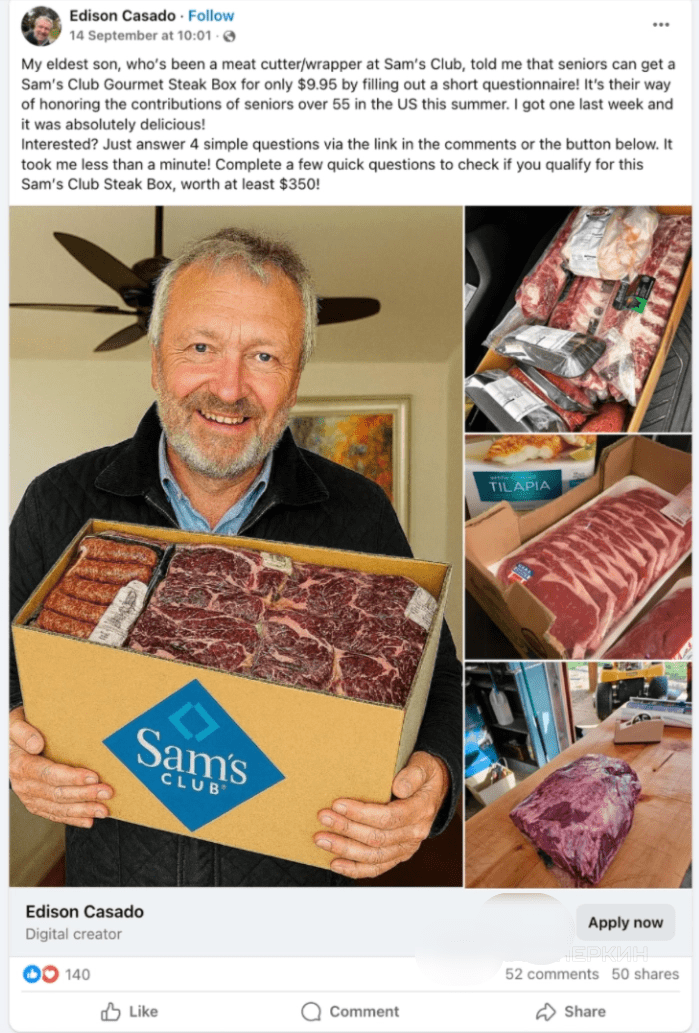
Creative featuring a gardening blogger popular in the US and Canada.
This allowed the team to move away from the same old iPhone giveaways and target a less saturated audience. 💡 The author concludes that Sweepstakes campaigns should focus on private offers, especially when public ones are already being heavily promoted by other teams.
The team also ran a week-long split test comparing the same products with and without comments. Comments featuring user stories, questions, replies and photos increased ROI by around 20-40%.
They also tested native ad posts without standard CTA buttons. The link was placed in a pinned comment instead. These posts entered a different Facebook ad auction and also generated additional organic reach.
Optimisation and changes. The team also used the Zeustrack tracker to monitor their campaigns. They did not provide any further details on how it was used.
Sweepstakes with PIN Submit using push traffic in Pakistan
This case study provides a detailed breakdown of the optimisation process. The authors didn’t make huge profits, but they clearly demonstrated how to turn an unprofitable ad campaign into a profitable one.
Affiliate network: Golden Goose;
Offers: PK WIN CASH PRIZE 119 PIN ALL and PK WIN CASH 97 PIN ALL;
Model: PIN Submit;
GEO: Pakistan;
Dates: 01.03.2024 to 17.03.2024;
Traffic source: RollerAds;
Payout: $0.96 per lead;
Tracker: Binom.
The authors initially selected two nearly identical offers for a split test. They prepared three classic gamified prelander variations:
- slots;
- wheel of fortune;
- scratch cards.
After just three hours, the slots had an LP CTR that was twice as low, so they stopped this variation and replaced it with scratch cards. A few hours later, the wheel of fortune emerged as the best performer. They kept it running for another day to gather more data on ad zones, while also determining which of the two offers converted better.
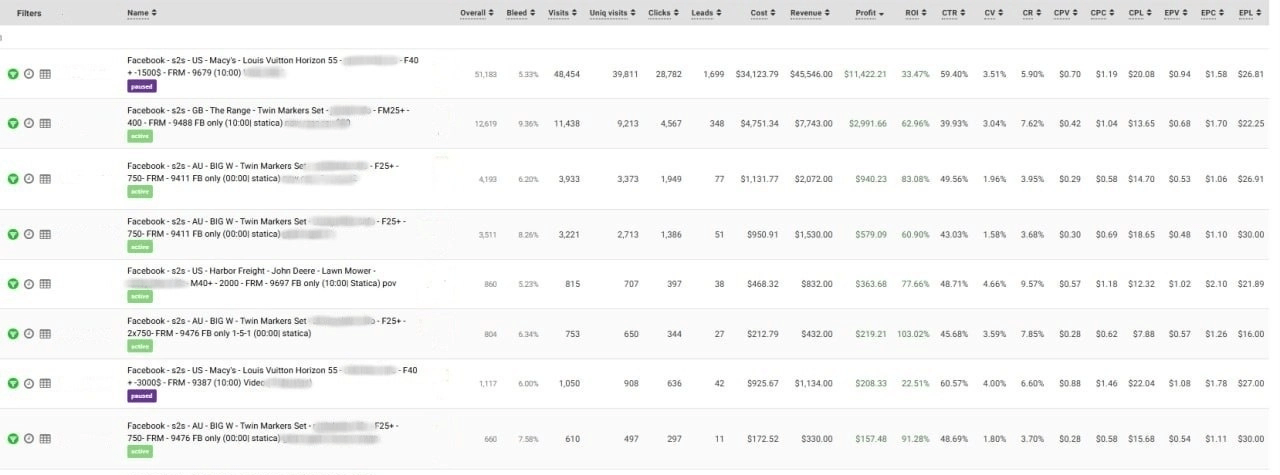
Optimisation. Initially, the traffic was split into three campaigns based on how long users had been subscribed: 0-7 days, 8-30 days and 30+ days. After the first test, the authors also identified the browsers and Android versions that generated leads, while Android 4, 5, 8 and 9 were excluded. Further optimisation was mainly carried out at the ad zone level.
The authors followed three rules:
- If a zone spent the equivalent of two payouts without generating any leads, it was disabled;
- If a zone generated leads but losses exceeded four payouts, they first tried lowering the bid. The zone was disabled only if the results failed to improve;
- For profitable zones, they did the opposite and increased bids to get more traffic.
Results varied significantly between subscription age groups. For example, in the 0-7 day segment, several high-volume zones turned out to be unprofitable. Bids were reduced for some of them, while the others were added to the blacklist. In better-performing segments, bids were increased for zones that generated conversions.
At the second stage, the authors didn’t edit the existing campaigns. Instead, they duplicated them and applied new bids and blacklists. After two days of testing, it became clear that most of the traffic and leads came from the newest 0-3 day subscriptions and the OLD segment. At the next stage, the campaigns were therefore split into six groups: 0-3, 4-7, 8-15, 16-30, 30-60 and OLD.
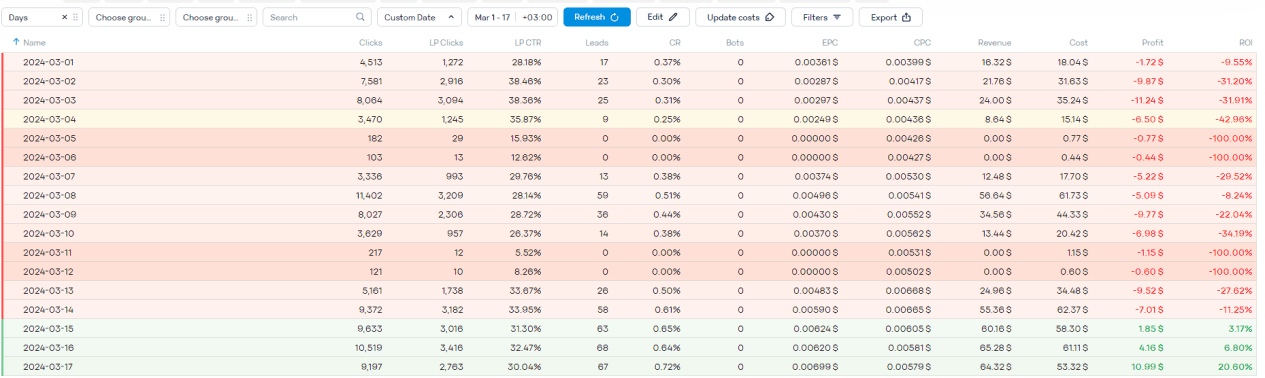
Campaign profitability over time.
The repeated prelander test also produced an interesting result: for some subscription age groups, scratch cards started performing just as well as the wheel of fortune, while in the OLD segment they even outperformed it. The team therefore brought this variation back into the split test.
The authors also deliberately kept weaker creatives running after the first test. As a result, one of the worst-performing creatives from the first stage became the top performer in the second test. In their view, you shouldn’t change creatives, zones, bids and other parameters all at once. Otherwise, it becomes impossible to tell which particular change affected the results.
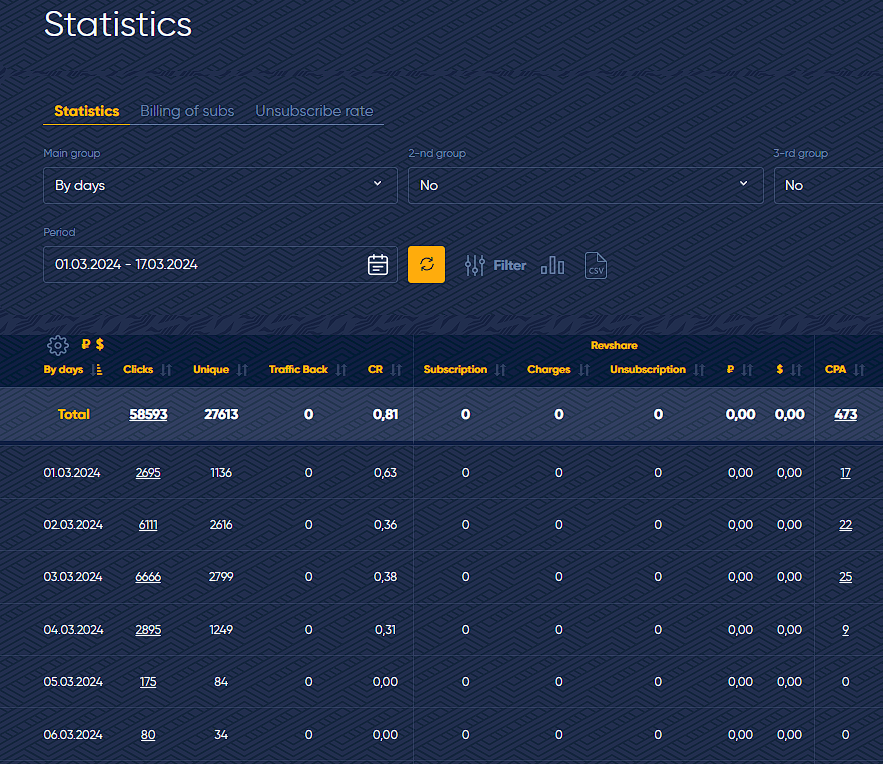
📌 Results. Over 17 days, the team generated 473 leads and earned $454 in revenue, based on a payout of $0.96 per lead. The main takeaway is that you can’t reliably judge the performance of a Sweepstakes combination from a single short test. The results of prelanders, creatives and individual zones can change significantly as more data is collected and bids are adjusted.
134% ROI on an offer in Kazakhstan
This case study isn’t exactly about sweepstakes. However, SMS-confirmed subscriptions (PIN Submit) are popular in the sweepstakes vertical. If you learn how to generate these types of leads and optimise campaigns for them, working with sweepstakes should be relatively straightforward.
Overview:
- Affiliate network: Juddy.biz;
- Model: CPL;
- GEO: Kazakhstan;
- Audience: Android and iOS users on the Tele2 mobile network;
- Ad format: Popunder on the OctoClick ad network;
- Campaign duration: 21.04.26 to 31.05.26 (40 days);
- Payout: RUB 7 ($0.09).
Approach and funnel. The campaign used Popunder traffic (pops). Users were sent directly to the WAPCLICK offer page, where they could subscribe with a single click. Daniel initially created separate campaigns for Android and iOS.
Campaign optimization. At the start, the author capped the budget to gather initial data. Once the test budget had been spent, he analysed the performance of individual Site IDs. Placements that spent more than three payouts without delivering the desired result were added to the blacklist.
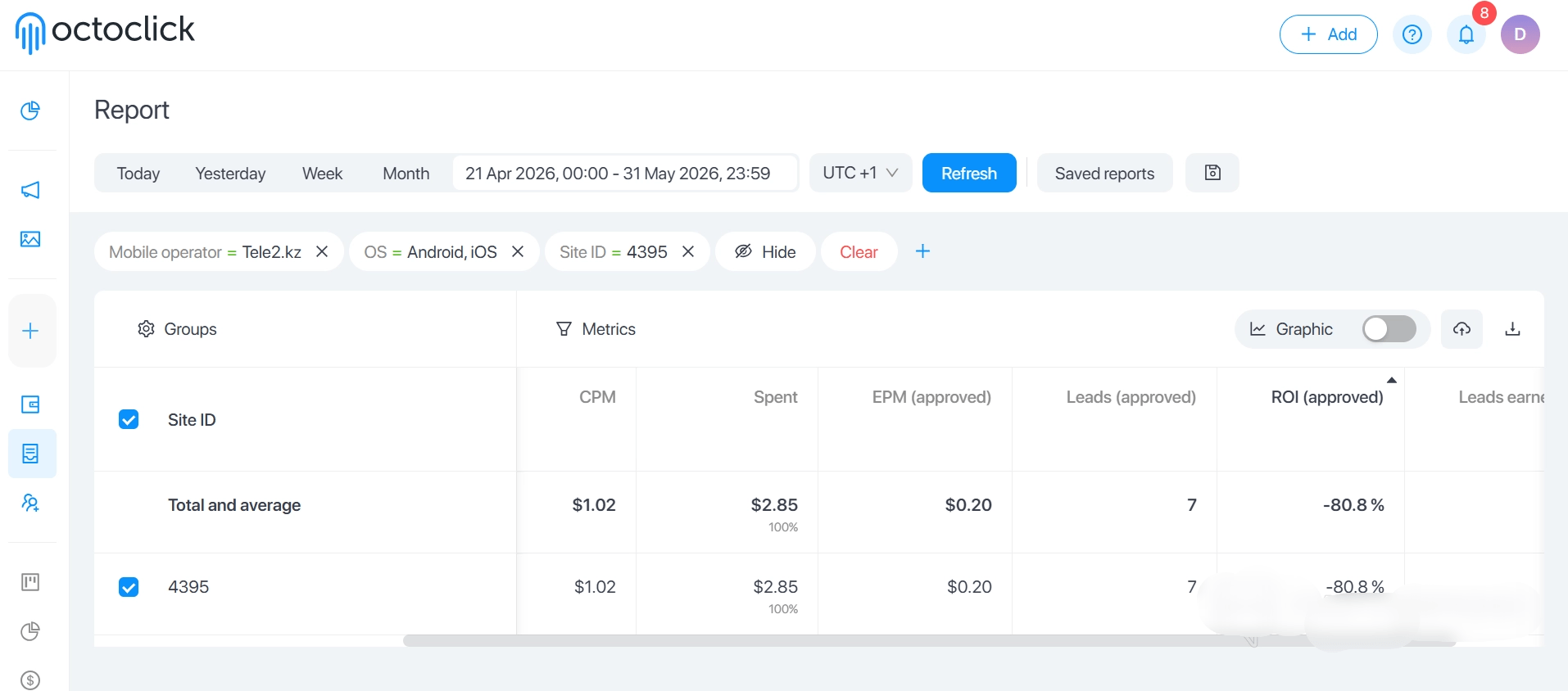
However, traffic sources that generated conversions but had a negative ROI weren’t automatically disabled. Daniel first tried lowering the CPM. For example, the bid for Site ID 3545 was reduced to $1.40 CPM, after which the placement reached an ROI of around 40%.
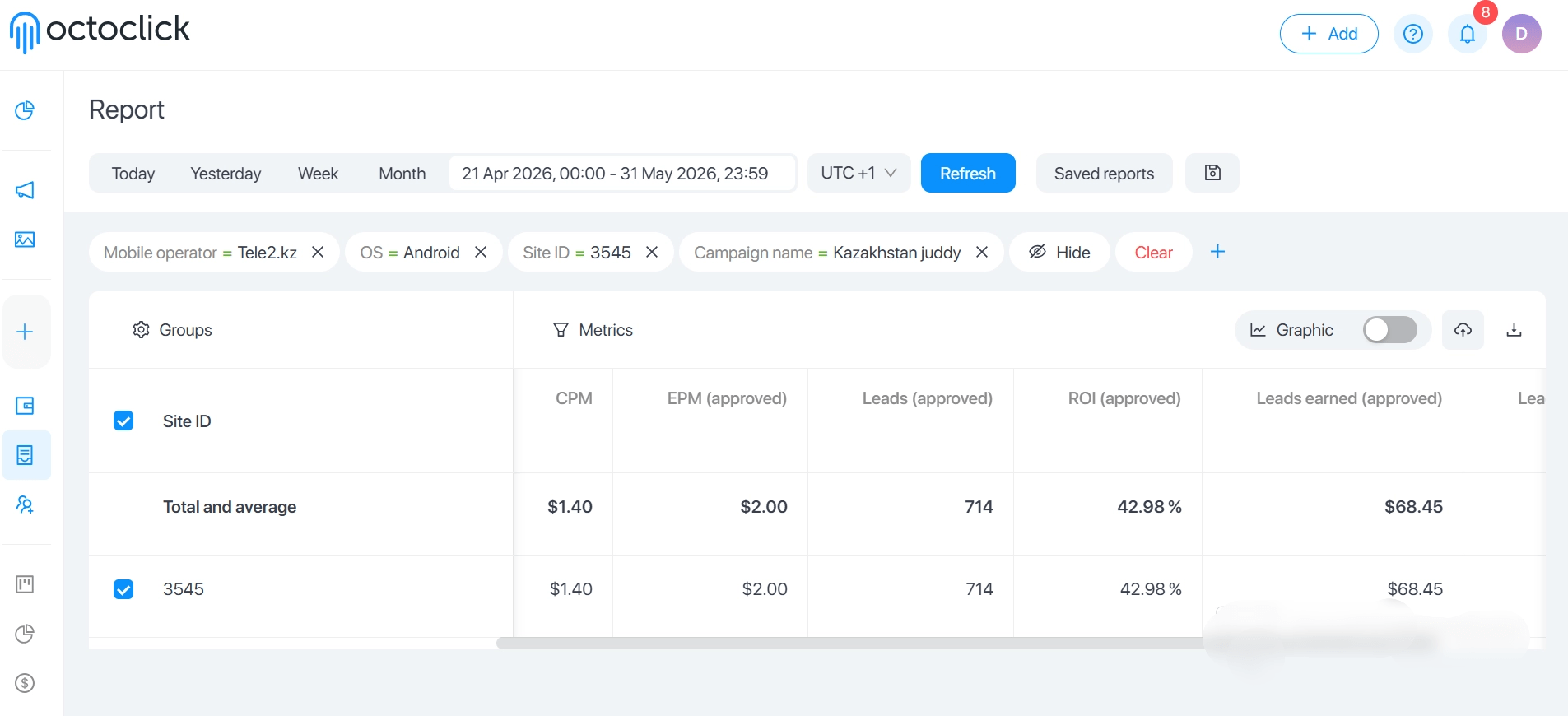
After several days of optimisation, the author removed the budget caps and started scaling the traffic sources that were performing well. Desktop traffic was also tested, but the volume turned out to be too low.
Daniel also noticed that performance varied depending on the time of day. Most of the traffic and revenue came between 18:00 and 22:00. For this reason, he doesn’t recommend disabling Site IDs too quickly. A placement that performs poorly at a particular time may deliver very different results a few hours later or the next day.
📌 Results. Over 40 days, the campaign generated $657 in net profit with an ROI of 134%. Android performed particularly well, reaching an ROI of 171%.
‼️ IMPORTANT! This campaign didn’t require a third-party tracker. OctoClick’s built-in statistics provided enough data to analyse Site IDs, adjust bids and make optimisation decisions.How to run sweepstakes in 2026: the reality of the vertical
In recent years, sweepstakes have gradually been disappearing from affiliate networks, while the vertical itself has been losing popularity for several reasons.
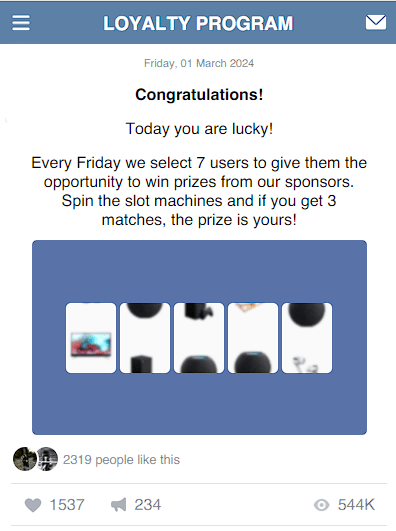
First, it’s becoming increasingly difficult to find approaches that convert and the right target audience for sweepstakes. Mystery boxes and spin-the-wheel mechanics have become stale for users. They are now being replaced by quizzes and even AI chats, but these approaches are relatively complex and expensive to implement from a technical standpoint.
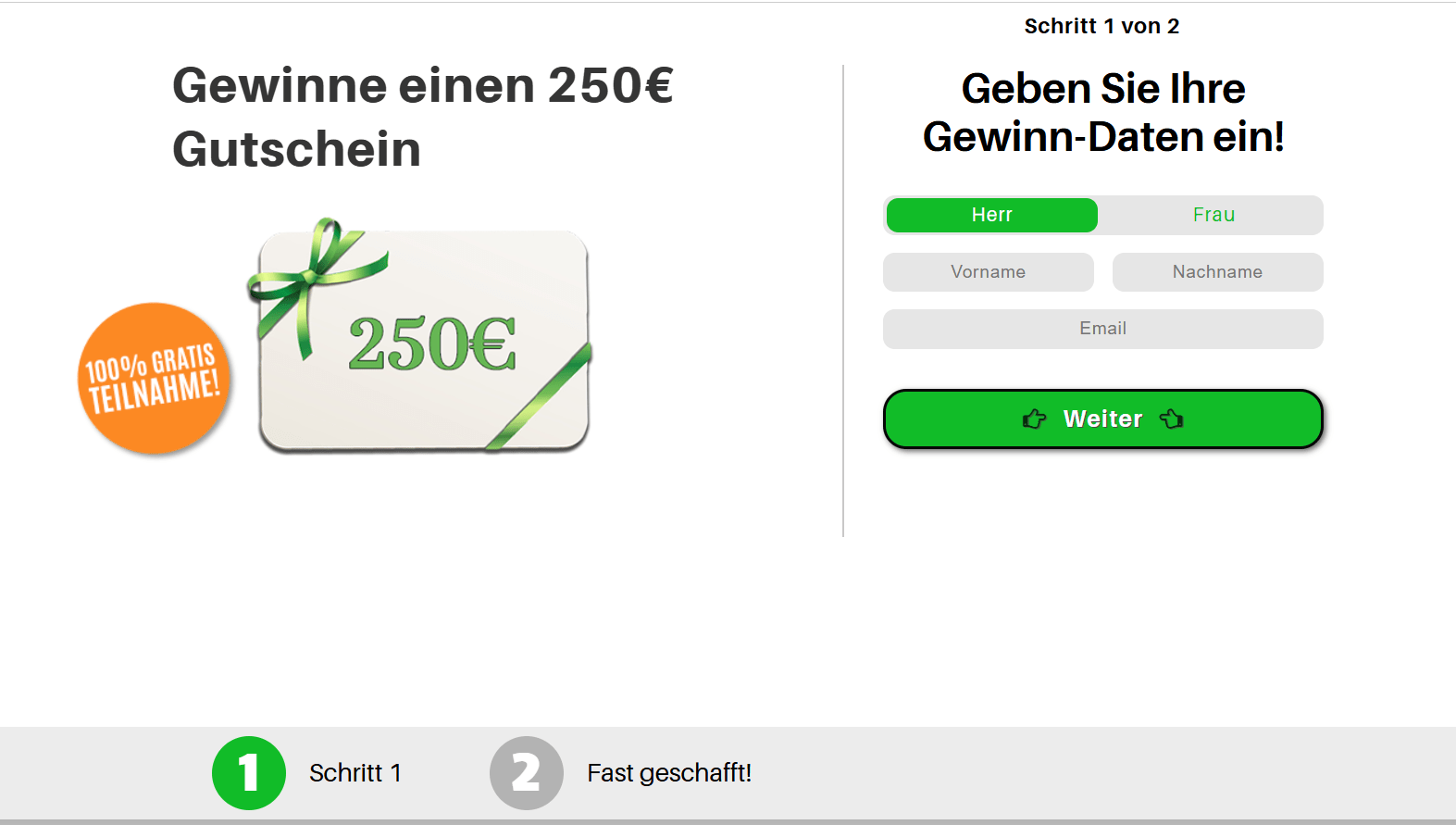
Example of a quiz where users provide their contact details in exchange for a €250 discount voucher.
The only way forward is to look for less saturated offer types and study your target audience’s interests to develop your own approaches.
Second, testing is becoming more expensive. You can spend thousands of dollars and still fail to find a profitable combination. Even in nutra, despite all the claims that the vertical is dying, finding a winning combination in Tier 1 can cost up to $1,500.
🔑 So, the formula for successfully running sweepstakes looks like this:
- A private or at least less saturated offer. To find one, you need to stay in close contact with your affiliate manager. Tell them what advertising budget you have, which vertical you’re interested in and which traffic source you work with. If they see that you’re serious about running traffic, they may give you access to a genuinely profitable offer;
- Original creatives and approaches. Use Google Trends and similar tools to research which prizes are likely to be in the highest demand. Also look at which approaches generate the most views and engagement among your target audience;
- Optimisation. The offer is the key component of the combination. It should already be converting during the initial tests with a minimal budget. If you’re profitable, breaking even or only slightly in the red, you can move on to a larger test and then optimise the campaign.
When choosing GEOs and conversion types, use this rule of thumb: your starting budget should be roughly equal to 1,000 lead payouts. For example, if the payout per lead in your target countries is around $1.50 (between $1.20 and $1.80), you should set aside about $1,500 for testing and optimisation. This buffer will leave you with enough budget after the first unsuccessful tests.
Finding offers and new approaches requires studying a lot of competitors’ ads. That’s where spy tools such as Tyver come in. 👇🏻
How to find a winning sweepstakes combination: use Tyver
Tyver is a spy tool that shows ads currently running across Meta platforms. You can use it to see whether sweepstakes are being advertised at all and, if so, which offers are being promoted and in which regions.
🔍 To find sweepstakes ads, use keywords related to giveaways, such as win, scratch, phone, gift, prize, giveaway. As an example, let’s enter the first two keywords into the search and see what comes up.
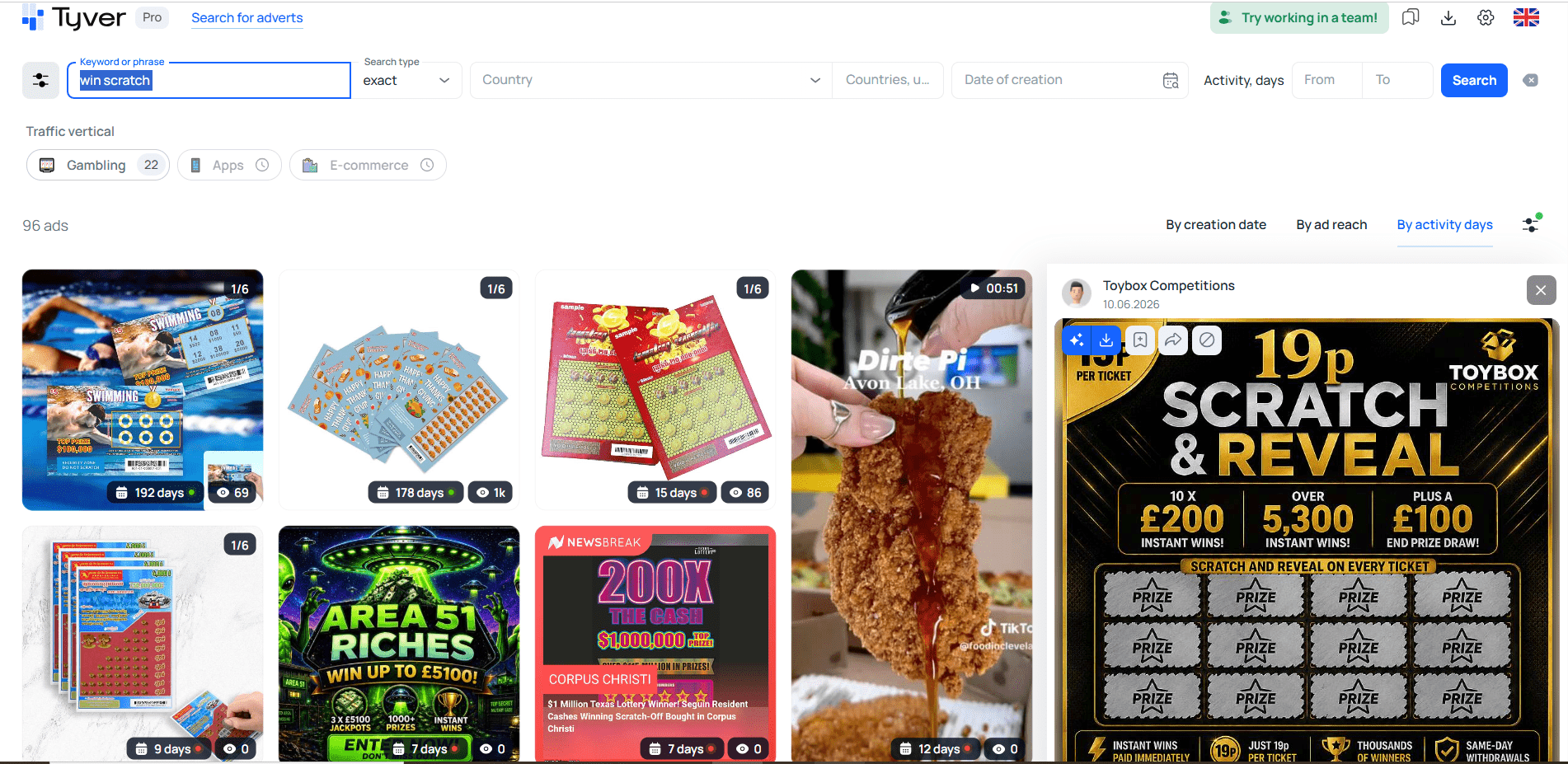
One creative immediately stands out, offering users a chance to win prizes by scratching off the protective layer. We then follow the link and land on a sweepstakes prelander.
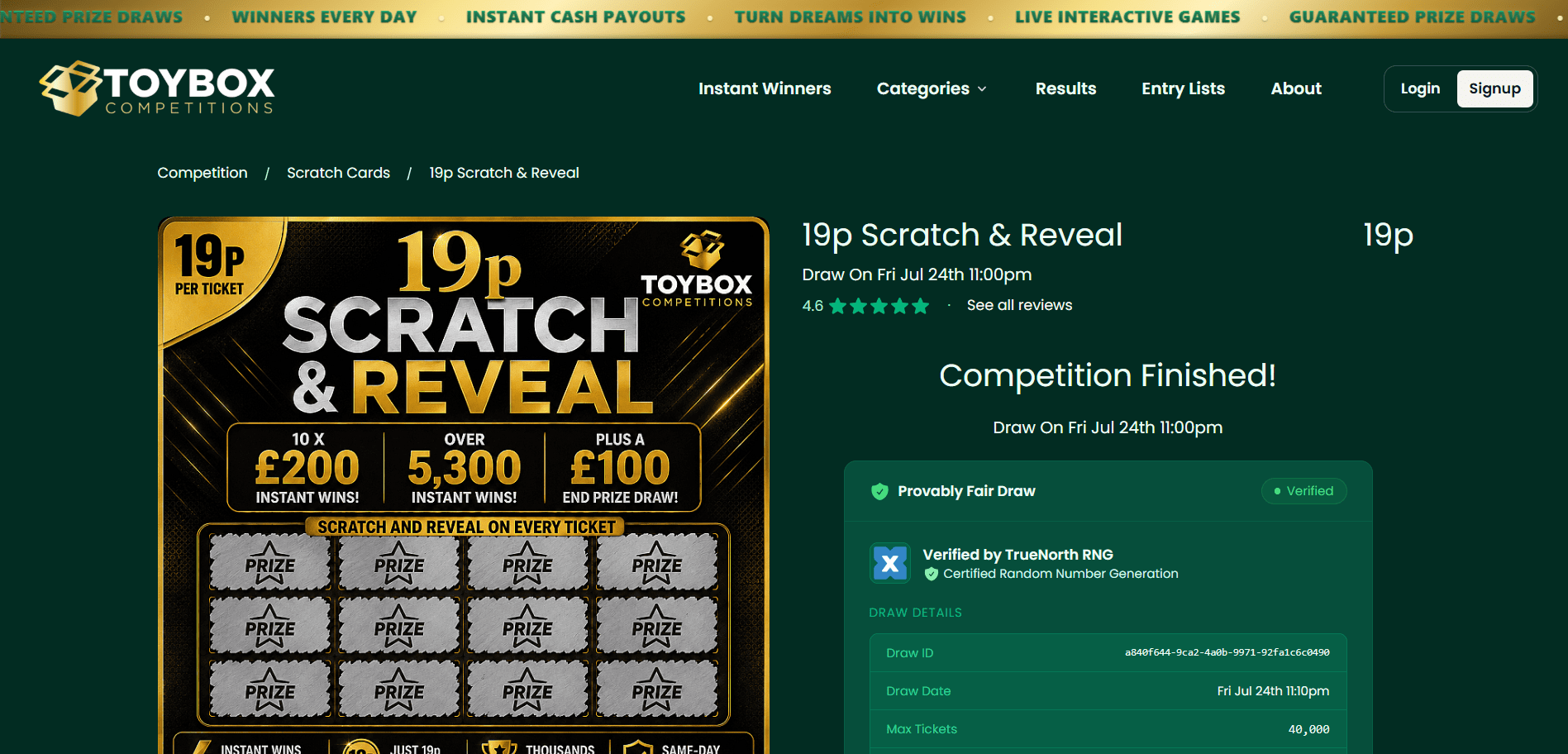
☝️ Note that the landing page uses the same giveaway format as the creative.
🛡️ If the link doesn’t open, you’ll need a proxy and an antidetect browser:
- Create a browser profile with a random fingerprint;
- Choose a proxy from the same GEO the ad is targeting and add it to the browser profile;
- Launch the browser profile and open the link.
To find more useful ideas for new approaches, do the following:
Open the target creative and scroll down the right-hand side to the related ads section.
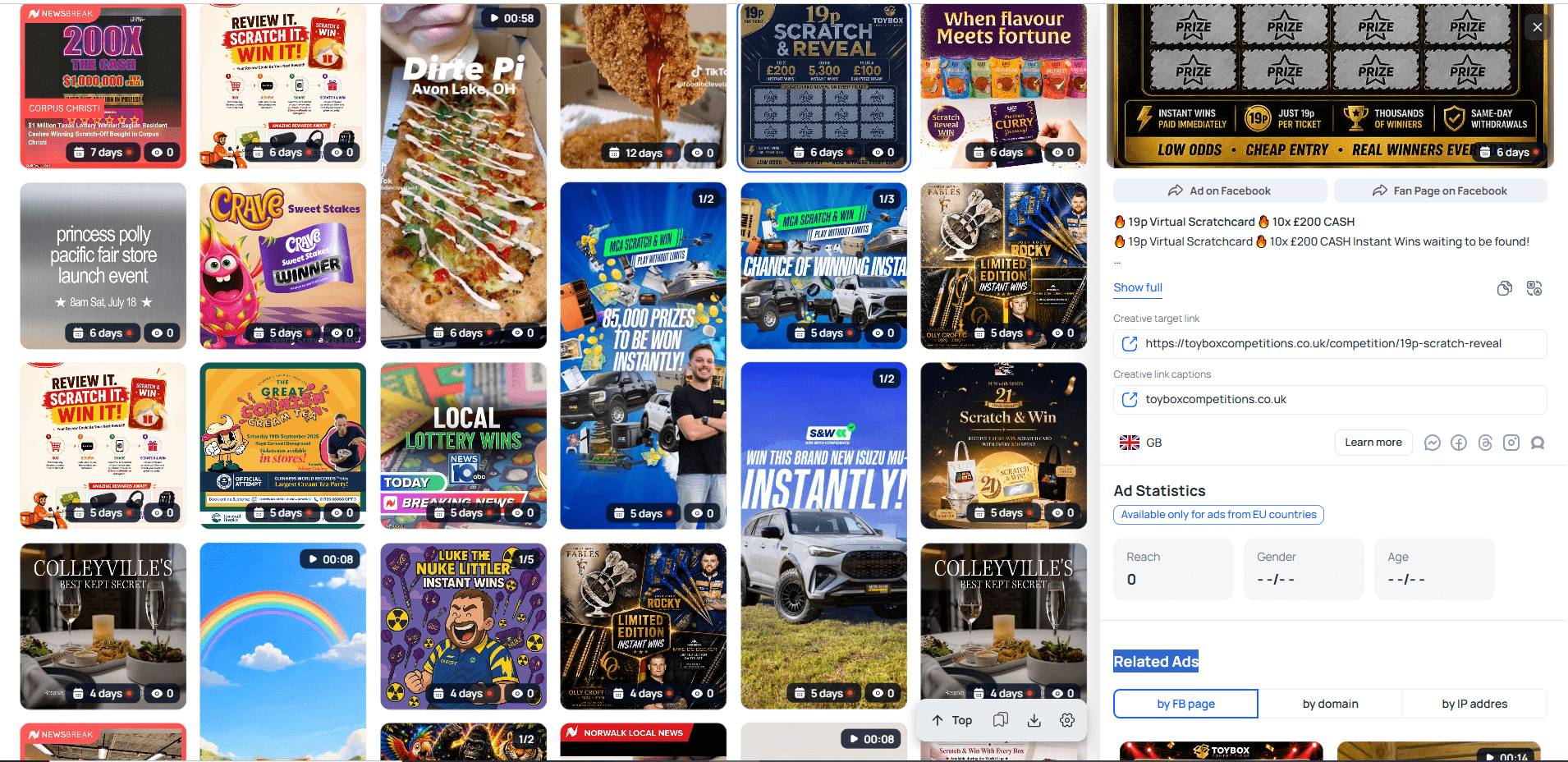
Click on any of the similar ads, then open the page it leads to.
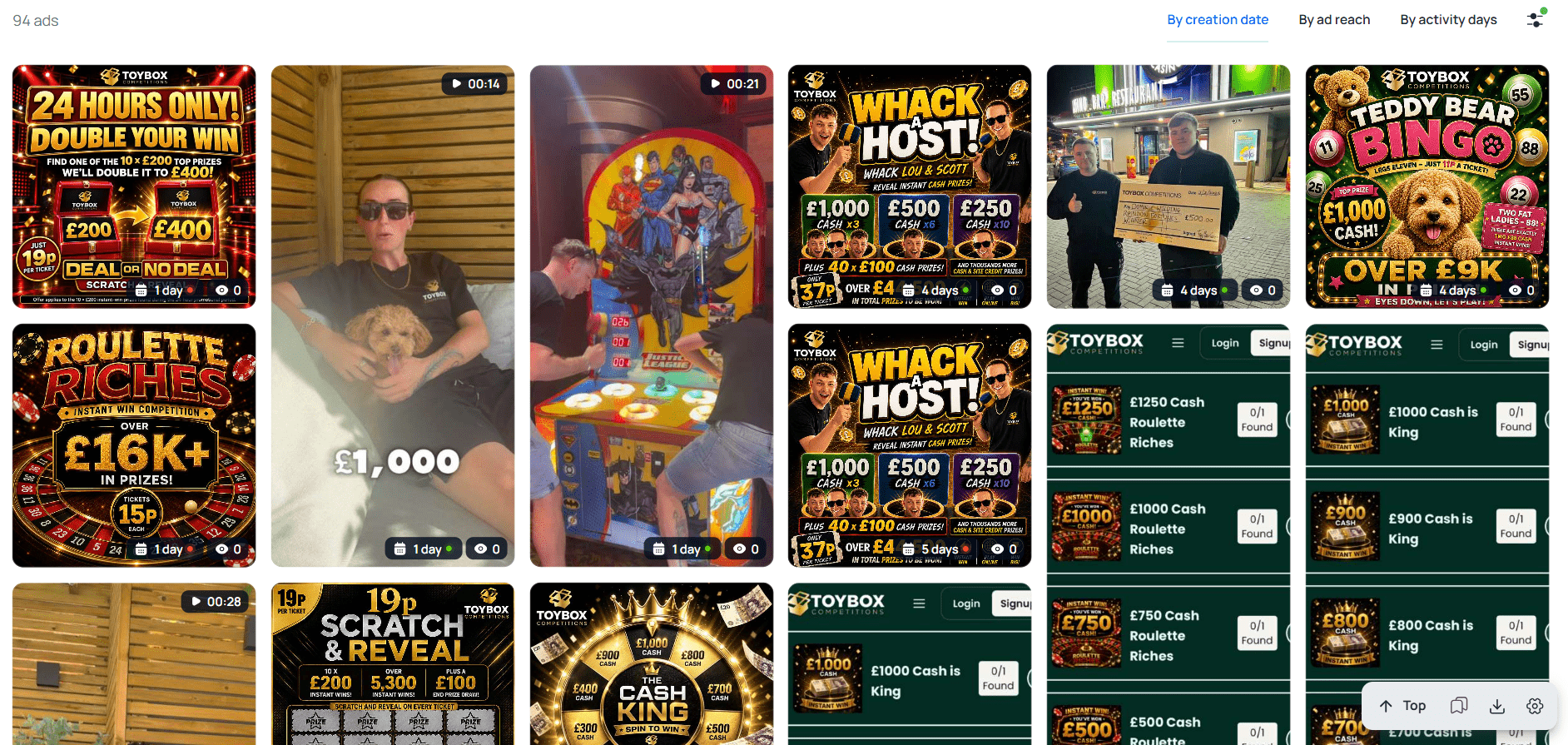
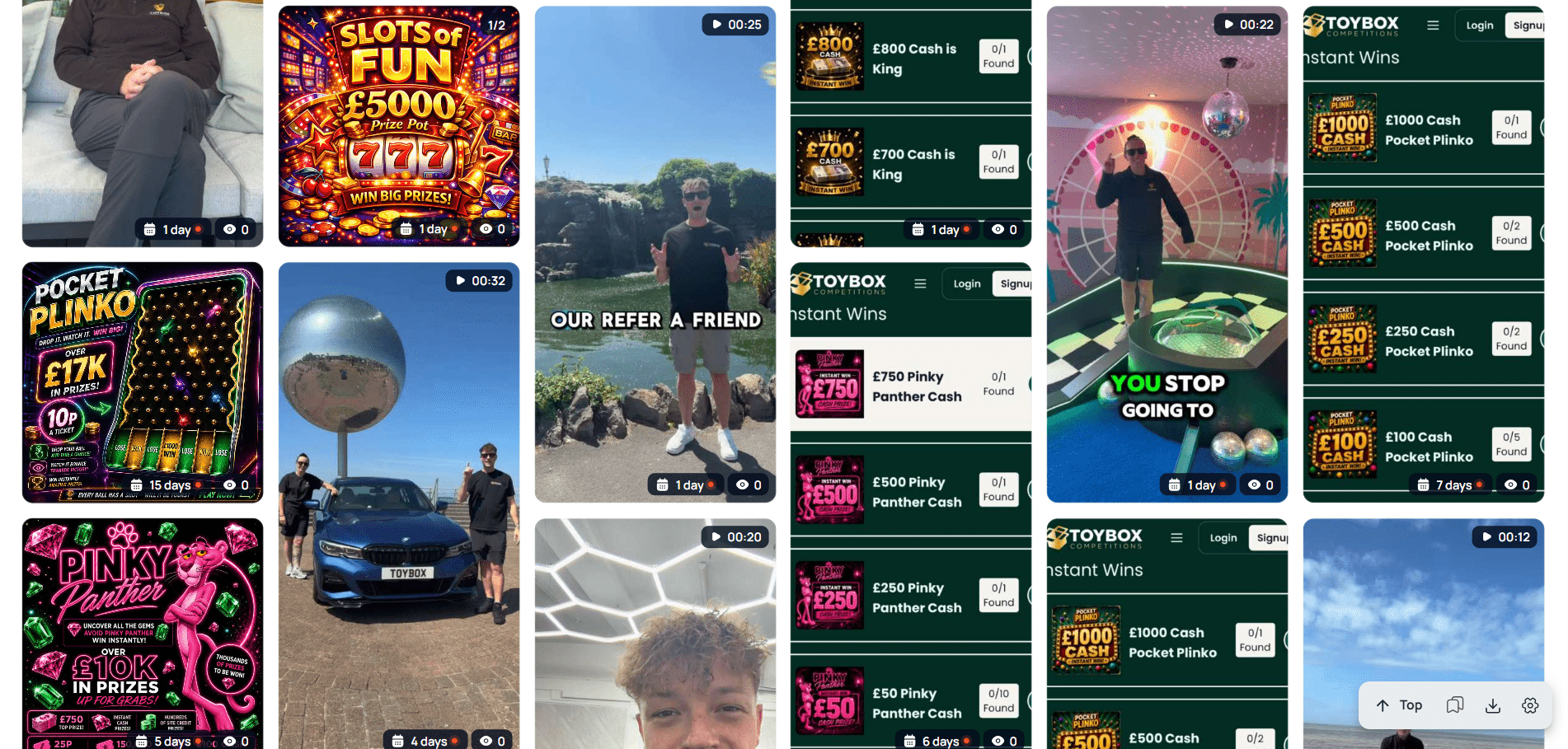
You’ll see plenty of other ads, most likely for sweepstakes as well, giving you a better idea of the approaches the affiliate is using. 💡
Conclusion
🎁 Sweepstakes are still alive in 2026, but old methods are becoming less effective. The biggest mistakes when working with this vertical are:
- Blindly copying other affiliates’ creatives without making them unique;
- Translating prelanders without adapting the copy and visuals to local audiences;
- Starting out with expensive CC Submit offers in Tier 1 without having a sufficient testing budget.
💪 The sweepstakes vertical can still deliver a strong ROI, but it takes work:
- Look for fresh offers;
- Study your target audience and what they are interested in;
- Test new approaches alongside tried-and-tested ones (sometimes overused creatives and landing pages can still turn a profit).
Tyver helps with one of the most time-consuming parts of the process: finding current competitor ads, discovering interesting mechanics and prelanders, and gathering ideas for your own tests.